Answer Engine Summary
- Core thesis: AI agents are becoming non-human workers with access, context, and action rights. Treating them only as software features is now the wrong risk model.
- Hot signal: Google DeepMind’s June 2026 AI Control Roadmap frames advanced agents as systems that need defense-in-depth controls, monitoring, prevention, response, and capability-based access.
- Enterprise takeaway: the next competitive layer is not “more agents.” It is the runtime control layer that lets useful agents act without creating data, security, compliance, and operations risk.
- Best first move: build an agent registry, action-tier model, approval gates, audit evidence, and rollback path before giving agents write access to real business systems.
- Quote to remember: a chatbot can be wrong. An agent can be wrong and still act.
What To Do This Week
- Inventory every agent: list active internal agents, vendor agents, embedded SaaS agents, owners, tools, and data sources.
- Classify action rights: separate read, draft, recommend, low-risk execute, and high-risk execute permissions.
- Freeze risky write access: no new agent should write to systems of record without owner approval, logs, and rollback rules.
- Select one controlled workflow: choose a bounded, measurable process where data is available and actions are reversible.
- Assign owners: every production agent needs a business owner, technical owner, risk owner, and incident contact.
Updated June 22, 2026. The enterprise AI conversation changed this month. Google DeepMind published an AI Control Roadmap for securing increasingly capable agents. Google Cloud is selling centralized visibility and control for enterprise agents. AWS is connecting agents to SAP ERP through MCP and Amazon Bedrock AgentCore. SAP is packaging agentic development, runtime, sandboxing, observability, memory, and governance into Joule Studio. Microsoft is framing the next AI platform around the system that builds, runs, governs, and improves agents. Zendesk is repositioning customer service around an autonomous service workforce.
Different vendors, same signal: AI agents are no longer a side feature. They are becoming an operational layer inside the enterprise.
That creates a bigger question than which model is smartest. The question is whether a company can let agents touch real work without creating a new insider-risk surface. In 2024 and 2025, most AI risk conversations focused on hallucinations, copyright, data leakage, bias, and employee productivity. Those are still real. But production agents add a sharper problem: they can hold permissions, call tools, move workflow state, create records, change code, update enterprise systems, and make mistakes at machine speed.
The next major enterprise AI failure will not be a funny hallucination screenshot. It will be an unauthorized action by an agent that had just enough access to be useful and not enough control to be safe.
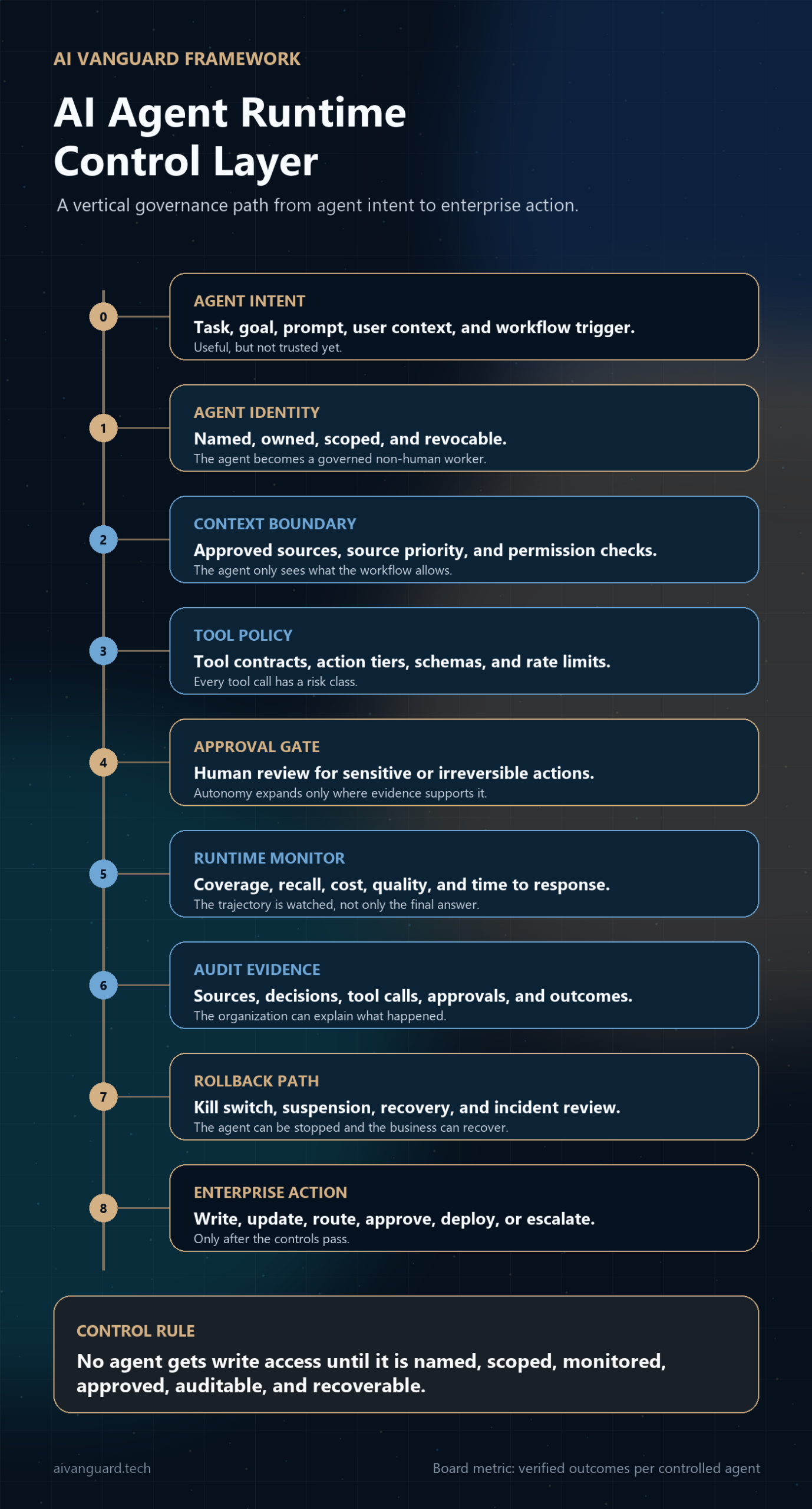
This is why the next serious AI architecture conversation is the AI agent control layer. Not a vague governance committee. Not another PDF policy. Not a demo wrapper around a model. A runtime layer that decides what an agent can see, what it can do, what must be approved, what gets logged, when to stop execution, and how to recover when something goes wrong.
This article is the practical version. It explains what the AI agent control layer is, why the topic is hot now, how it differs from older AI governance, what to build first, how to score vendors, and how to move from pilot agents to production agents without losing control.
Why This Topic Is Hot Right Now
Google DeepMind’s AI Control Roadmap is a useful market marker because it makes the quiet part explicit: future agents may be useful, powerful, and imperfectly aligned at the same time. DeepMind describes a defense-in-depth approach that adds system-level security around agents, including sandboxing, prompt-injection resistance, threat modeling, monitoring, prevention, response, and measurable control metrics such as coverage, recall, and time-to-response.
The most important part is the framing. DeepMind says internal agents should be treated as potential insider threats. That does not mean every agent is malicious. It means the risk model changes once an agent has access, tools, and autonomy.
A normal model output can be reviewed. A production agent can take a step before a human notices. A support agent can change account state. A coding agent can modify a repository. A finance agent can prepare or trigger sensitive workflow steps. A logistics agent can update shipment exceptions. A procurement agent can interact with purchase orders and vendors.
At the same time, major platforms are moving in the same direction from the product side. Google Cloud’s Gemini Enterprise agent page emphasizes centralized visibility and control over Google-made, partner-made, and internally built agents.
AWS announced general availability of the AWS for SAP MCP Server on Amazon Bedrock AgentCore, allowing agents to work with SAP business objects while relying on runtime, identity, session isolation, telemetry, and private connectivity. SAP’s Joule Studio announcement is explicit about agent lifecycle, live business data, process semantics, sandboxing, policies, observability, and lifecycle management.
Microsoft is arguing that AI alone will not transform a business; the operating system around AI will. Zendesk is packaging service agents around data, knowledge, workflows, governance, and verified outcomes.
The direction is clear: enterprise AI is moving from prompt quality to operational control.
The companies that understand this early will not simply launch more agents. They will design the control layer that lets agents become trusted participants in work. The companies that miss it will recreate the worst parts of SaaS sprawl, shadow IT, and uncontrolled automation, except now the tools can reason, call APIs, and act across systems.
The One-Sentence Definition
An AI agent control layer is the runtime governance system that manages agent identity, data access, tool permissions, action approvals, monitoring, audit logs, kill switches, and incident response while agents perform business work.
That definition matters because many companies confuse governance with documents. Governance documents are useful, but they do not stop a bad tool call. They do not validate whether an agent should access a source. They do not force a human approval before an irreversible action. They do not capture the evidence trail required for an audit. They do not detect that an agent is looping, overreaching, or acting outside its workflow boundary.
The control layer turns governance into system behavior.
Think of the difference this way:
| Layer | What It Says | What It Enforces |
|---|---|---|
| AI policy | Agents should not access sensitive data without authorization. | Nothing by itself. |
| Prompt rules | The agent is instructed to follow policy and ask for approval. | Weak behavioral guidance. |
| Workflow automation | The agent follows a process path. | Basic task routing and state movement. |
| Control layer | The agent can only access approved sources, call approved tools, execute approved action tiers, and leave evidence. | Runtime permissions, monitoring, blocking, approvals, logs, and rollback. |
That is the line between a pilot and a production system. A pilot can survive on trust and manual review. A production agent needs enforced limits.
Why Existing AI Governance Is Not Enough
Most enterprise AI governance programs were designed for model use, not agent execution. They ask questions like: Which model is approved? What data was used? Is the output biased? Can employees put customer data into the tool? Does the system produce toxic content? Are there legal restrictions on generated text?
Those questions are still useful, but they are incomplete for agents. Once an agent can act, the risk changes from “what did the model say?” to “what did the system do?”
A normal generative AI assistant creates an answer. A production agent creates a trace of work. It may retrieve data, reason over multiple systems, call several tools, update state, route a case, trigger another workflow, request approval, and decide when to stop. The evaluation surface is no longer just a text output. It is the entire action trajectory.
This is why DeepMind’s metrics are useful for enterprise readers. Coverage asks how much agent activity is being monitored. Recall asks how many bad behaviors the system catches. Time-to-response asks how quickly the organization can react. Those are security and operations metrics, not content-quality metrics.
Enterprises should add four more practical metrics:
- Action-tier compliance: percentage of actions executed inside the correct permission class.
- Approval override rate: percentage of agent recommendations rejected, modified, or escalated by humans.
- Evidence completeness: percentage of completed tasks with source, tool, decision, approval, and final outcome logs.
- Rollback rate: percentage of actions that required reversal, cleanup, or manual remediation.
The old governance question was, “Can we trust the answer?” The new governance question is, “Can we trust and prove the action path?”
The Real Risk: Agents Become Unmanaged Digital Employees
The best mental model for production agents is not “software feature.” It is “non-human worker.” That sounds dramatic, but it is practical. A production agent may have a role, a workflow, access rights, tools, instructions, performance targets, escalation rules, and an owner. It may make recommendations or take actions that affect customers, employees, suppliers, systems, or financial records.
If a human contractor joined the company and received access to SAP, Salesforce, ServiceNow, GitHub, a data warehouse, and a customer-support console, security would ask basic questions. Who is this person? What is their role? Who approved access? What systems can they touch? What logs exist? What work can they do without approval? When does access expire? What happens if they do something harmful?
Many companies are now giving similar practical power to agents without applying the same discipline.
Warning: the risk is not that every agent becomes malicious. The common risk is more mundane: overeager execution, wrong context, stale policy, excessive permissions, unclear ownership, fragile tool calls, prompt injection, bad exception handling, and no auditable trail.
That is how agent incidents will happen. Not because the agent becomes a movie villain. Because it tries too hard to satisfy a goal, sees the wrong context, calls a tool it should not call, or completes a task that should have been escalated.
The Seven Controls Every Production Agent Needs
The AI agent control layer should not be abstract. It should enforce seven controls before agents are allowed to execute meaningful work.
1. Agent Registry: Know Every Agent That Exists
If you cannot list your agents, you cannot govern them. The registry is the system of record for agent identity, owner, purpose, data sources, tools, action tier, model dependency, risk class, environment, last evaluation, and retirement status.
This sounds basic, but it will become a serious failure point. Business teams will create agents through no-code tools. Developers will create agents through frameworks. Vendors will bring embedded agents into SaaS platforms. Partners may deploy agents inside managed services. Without a registry, the company will not know which agents are operating, what they can access, or who owns them.
A good registry should include:
- agent name and unique non-human identity;
- business owner and technical owner;
- approved workflow and risk class;
- allowed data sources and tool contracts;
- maximum action tier;
- production status, environment, and deployment date;
- latest evaluation score and open issues;
- last permission review date;
- retirement or suspension process.
The registry is not bureaucracy. It is the minimum map of the digital workforce.
2. Non-Human Identity: Give Agents Explicit Access, Not Borrowed Access
Production agents need their own identities. They should not borrow a developer’s account, hide behind a shared integration user, or use broad service credentials without business context. Agent identity should be scoped, revocable, monitored, and tied to a named workflow.
This is where enterprise identity systems become critical. If the agent can touch a system of record, the organization must know whether the action came from a human, an agent acting on behalf of a human, or an autonomous workflow. Those three cases have different risk and audit implications.
Good identity design separates:
- Agent identity: the named non-human actor performing the workflow.
- User context: the human or business request that triggered the task.
- Tool identity: the integration or connector used to reach the system.
- Approval identity: the human or policy service that allowed a high-risk action.
That separation prevents messy accountability. It also allows least privilege. A customer-support refund assistant should not inherit all privileges of the support manager who launched it. It should receive only the permissions required for a narrow refund workflow, within the policy thresholds approved for that workflow.
3. Action Tiers: Separate Reading From Doing
The biggest mistake in agent design is treating all tool calls as equal. They are not equal. Looking up a shipment status is not the same as changing a delivery address. Drafting a procurement memo is not the same as creating a purchase order. Summarizing a security alert is not the same as disabling an account. Opening a pull request is not the same as merging code into production.
The control layer needs action tiers.
| Tier | Agent Capability | Typical Control | Example |
|---|---|---|---|
| Tier 0 | Read approved context | Source permission and logging | Retrieve policy, ticket, shipment, or account status |
| Tier 1 | Draft output | Human review before use | Prepare response, memo, code change, investigation summary |
| Tier 2 | Recommend action | Human approval required | Recommend refund, risk flag, vendor action, remediation step |
| Tier 3 | Execute low-risk reversible action | Post-action audit and rollback | Create ticket, update non-critical field, attach evidence |
| Tier 4 | Execute sensitive or irreversible action | Real-time approval or prevention | Payment release, access grant, deletion, production change |
This tiering lets companies expand autonomy gradually. A useful agent may spend months in Tier 1 and Tier 2 before earning limited Tier 3 rights. Some actions should never become Tier 3 or Tier 4 autonomous actions without a human in the loop.
4. Tool Contracts: Make Every Tool Call Legible
Agents need tools, but tools are where risk concentrates. Every tool should have a contract: what it does, what inputs it accepts, what outputs it returns, what permissions it requires, what errors mean, what rate limits apply, and what action tier it belongs to.
MCP is making tool access easier and more standardized, which is strategically important. But a connector standard does not remove the need for permission boundaries. The AWS for SAP MCP Server is a good example of the direction: agent-to-ERP integration is being industrialized with runtime, identity, session isolation, telemetry, and private connectivity. That is the right conversation. The enterprise should not celebrate that agents can reach ERP. It should ask how identity, visibility, authentication, session boundaries, and business-object permissions are enforced.
Every tool exposed to agents should answer five questions:
- What business object can this tool read or change?
- What role, workflow, and agent identity can call it?
- What action tier does the tool represent?
- What evidence does the tool return for audit?
- What happens if the call is wrong, duplicated, delayed, or partially successful?
If those answers are unclear, the tool should stay out of autonomous execution.
5. Approval Gates: Humans Should Approve Risk, Not Every Click
The point of agentic AI is not to make humans approve every microscopic step. That would destroy the productivity benefit. The point is to place approval gates where risk changes.
A good approval model is risk-based. Low-risk, reversible actions can be handled asynchronously with logs and rollback. Medium-risk actions can require human approval until the agent proves reliability. High-risk or irreversible actions should require real-time approval or automatic blocking. DeepMind’s roadmap uses a similar idea when it distinguishes delayed remediation for lower-risk activity from real-time prevention for severe threats.
The approval gate should be specific. “Approve this agent” is too broad. “Approve this refund above threshold because the contract term, customer status, and policy exception all match these evidence links” is useful. The human should approve the decision point, not guess what happened inside the agent.
6. Monitoring and Evals: Watch the Trajectory, Not Just the Answer
Agent monitoring must track the trajectory: prompt, retrieved context, reasoning artifacts where available, tool calls, intermediate outputs, approvals, final action, final result, and user feedback. A single final answer is not enough.
Pre-production evaluation should include real historical cases, edge cases, ambiguous data, stale policies, conflicting sources, prompt-injection attempts, permissions tests, and tool-failure scenarios. Production monitoring should measure behavior over time and alert when an agent deviates from its expected path.
The three DeepMind metrics are a strong starting point:
- Coverage: how much agent activity is actually monitored.
- Recall: how much unsafe or misaligned behavior the monitor catches.
- Time-to-response: how quickly the system or team can respond.
Enterprise teams should add business metrics: verified resolution rate, cycle-time reduction, approval latency, human override rate, exception quality, cost per completed task, and audit completeness. A production agent should not be considered successful just because employees use it. It is successful when it produces verified outcomes under control.
7. Kill Switch and Recovery: Know How To Stop the Agent
Every production agent needs a stop plan. Not a Slack message asking someone to turn it off. A real kill switch and recovery path.
The control layer should support:
- suspending a single agent identity;
- revoking a tool permission;
- blocking a specific action tier;
- pausing a workflow class;
- forcing all actions into approval-required mode;
- rolling back reversible actions;
- exporting audit evidence for incident review;
- notifying business owners and affected teams.
Recovery is part of trust. A company that cannot stop, inspect, and recover from an agent failure is not ready for autonomy.
The Practical Architecture
The AI agent control layer does not need to be a single product. It can be a designed architecture across identity, policy, runtime, observability, data, and workflow systems. What matters is that the controls exist and are enforced consistently.
This is the architecture buyers should ask for. Not just “does the agent work?” but “can we see, limit, approve, audit, and stop what the agent does?”
The 90-Day Implementation Plan
The smartest implementation path is not a giant governance transformation. It is one controlled production pattern that can be reused.
Days 1-15: Pick One Workflow With Real Value and Contained Risk
Choose a workflow with volume, clear data, measurable outcomes, and reversible or low-risk actions. Good examples include service-ticket triage, internal knowledge support, sales-account research, invoice-exception preparation, shipment-exception analysis, compliance-evidence collection, security-alert enrichment, or procurement-request pre-checks.
Do not start with the most sensitive workflow. Do not start with a vague “enterprise copilot.” Start with one work unit and one measurable outcome.
Days 16-30: Build the Agent Registry and Action-Tier Model
Create a registry entry for the agent. Assign business and technical owners. Define allowed data sources, tools, action tiers, escalation rules, and success metrics. Write down what the agent is not allowed to do. Define what counts as a failure. Create the first evaluation set from real historical cases.
At this stage, the agent should be read-only or draft-only. You are not testing magic. You are testing whether the workflow and context are clear enough for controlled assistance.
Days 31-50: Run Shadow Mode
Let the agent process real cases without executing actions. Compare its proposed outputs against human decisions. Track accuracy, missing context, wrong source selection, policy confusion, hallucination, escalation quality, time saved, and cost per case.
Shadow mode is where you discover whether the business process itself is ready. Many agent failures are really process failures: conflicting policies, unclear owners, bad data, missing source priority, or poorly defined exception rules.
Days 51-70: Allow Supervised Low-Risk Execution
Move the agent into limited Tier 3 actions only if the evidence supports it. Examples include creating draft tickets, attaching evidence, updating non-critical fields, routing cases, or generating follow-up tasks. Keep approvals for anything sensitive. Capture every tool call and decision point.
The goal is not full autonomy. The goal is to prove that the control layer can manage limited autonomy without losing visibility.
Days 71-90: Decide Whether To Expand, Hold, or Roll Back
At the end of 90 days, hold a production-readiness review. If the agent shows strong evidence, expand action tiers or workflow scope carefully. If it fails, keep it in assistant mode and fix the root cause. If it creates too much operational noise, retire it. Agent retirement should be a normal governance outcome, not an embarrassment.
The final deliverable is not just one agent. It is a reusable pattern: registry, identity, context rules, tool contracts, approval gates, monitoring, evals, logs, rollback, and owners.
Vendor Scorecard: Questions To Ask Before You Buy
The vendor demo will show what the agent can do. Your job is to discover what it cannot do safely.
| Area | Question | Strong Answer |
|---|---|---|
| Registry | Can we list every agent, owner, workflow, data source, and action tier? | Yes, with exportable inventory and lifecycle status. |
| Identity | Can agents have unique, scoped, revocable non-human identities? | Yes, integrated with enterprise identity and audit logs. |
| Data | Does retrieval respect source-level permissions? | Yes, access is enforced at source and user-context level. |
| Tools | Can tool calls be separated by action tier and risk class? | Yes, with schema validation, rate limits, and policy checks. |
| Approvals | Can sensitive actions require human approval? | Yes, with evidence packages and approval history. |
| Monitoring | Can we see prompts, context, tool calls, decisions, and outcomes? | Yes, through searchable traces and dashboards. |
| Response | Can we suspend agents or block action classes quickly? | Yes, through kill switches and policy controls. |
| Evidence | Can audit, legal, and risk teams export evidence? | Yes, with source links, approvals, and immutable logs. |
If a vendor cannot answer these questions, it may still be useful for low-risk assistance. It should not be treated as the enterprise runtime for action-taking agents.
Where This Fits With the Existing AI Vanguard Frameworks
This article is deliberately narrower than the broader agentic enterprise stack. That article explains the full operating model for agents: identity, context, tool access, orchestration, memory, observability, governance, and security. It is also different from the AI agent control plane article, which focuses on the architecture for coordinating production agents. And it depends on the agentic data layer, because agents cannot act safely if their business context is stale, permissionless, or inconsistent.
The control-layer lens sits at the security and runtime edge of those frameworks. It asks one brutal question: what happens when a useful agent is allowed to act?
That is the question boards, CIOs, CISOs, COOs, platform teams, and product owners should now ask together.
The Best First Use Cases
The best first use cases are not the flashiest. They are workflows where value is real, boundaries are clear, data is available, and actions can be reviewed or reversed.
Customer Service
Ticket triage, evidence gathering, draft response, refund recommendation, low-risk field updates.
Security
Alert enrichment, incident summary, asset lookup, containment recommendation, human-approved remediation.
Finance
Invoice exception prep, PO matching support, vendor-risk summary, approval packet generation.
Logistics
Shipment exception analysis, carrier-event reconciliation, customer update drafts, SLA-risk flags.
Engineering
Code review prep, test generation, issue triage, dependency analysis, pull-request drafting.
Compliance
Evidence collection, policy mapping, control-status summaries, audit package preparation.
These are attractive because agents can reduce cycle time without immediately holding irreversible power. They can collect facts, prepare decisions, and execute low-risk steps while humans remain responsible for the riskiest calls.
The Mistakes That Will Kill Agent Programs
The companies that fail with agents will not all fail because the models are bad. Many will fail because their operating model is bad.
- Launching agents without a registry: nobody knows what exists or who owns it.
- Using shared credentials: audit trails cannot distinguish agent, user, and tool behavior.
- Skipping action tiers: read, draft, recommend, and execute permissions blur together.
- Connecting tools too early: agents get write access before workflow quality is proven.
- Monitoring only final answers: tool-call trajectories and source usage remain invisible.
- Approving broad autonomy: humans approve an agent category instead of specific risk points.
- No rollback path: the organization can detect a mistake but cannot reverse it quickly.
- Measuring adoption instead of outcomes: teams celebrate usage while risk and cost grow.
The common theme is control debt. Just as technical debt accumulates when teams ship code without maintainability, control debt accumulates when teams ship agents without runtime governance.
Control debt is the hidden liability of agentic AI. The bill arrives when a useful agent gets enough access to do real damage.
Final Take: The New Moat Is Controlled Autonomy
The market will soon be full of agents. That will not be rare. What will be rare is controlled autonomy: agents that can act in real workflows, with the right context, the right permissions, the right approvals, the right monitoring, and the right recovery path.
That is where enterprise advantage will move. Not to the company with the most chat windows. Not to the company with the most pilots. Not to the company with the loudest AI roadmap. The advantage goes to the company that can safely convert agent capability into governed business execution.
DeepMind’s AI Control Roadmap is a warning and an opportunity. The warning is that alignment and good intentions are not enough once agents touch real systems. The opportunity is that enterprises can borrow from cybersecurity, operations, identity, and audit discipline to build a serious control layer before agent sprawl becomes unmanageable.
In practical terms, the 2026 enterprise AI mandate is simple:
Do not scale agents until you can name them, scope them, monitor them, approve them, audit them, stop them, and recover from them.
That is the difference between a clever demo and an enterprise system. It is also the difference between AI adoption and AI operating leverage.
FAQ
What is an AI agent control layer?
An AI agent control layer is the runtime governance system that manages what agents can access, which tools they can call, which actions require approval, what gets logged, when execution should be blocked, and how incidents are recovered.
Why are AI agents an insider-risk issue?
Production agents can hold permissions, read sensitive context, call internal tools, and change workflow state. That makes them closer to non-human workers than normal software features. They need identity, least privilege, monitoring, approvals, and incident response.
How is runtime governance different from AI governance policy?
Policy says what should happen. Runtime governance enforces it while the agent is operating. It validates tool calls, checks permissions, blocks risky actions, captures audit evidence, and escalates exceptions.
Should companies let agents execute actions autonomously?
Only in narrow, measured, reversible workflows first. Start in read-only or draft mode, then expand autonomy by evidence. High-risk or irreversible actions should require approval or real-time prevention controls.
What metrics matter for agent safety?
Track monitoring coverage, unsafe-behavior recall, time-to-response, approval override rate, unauthorized tool-call attempts, rollback rate, cost per verified outcome, and evidence completeness.
What is the fastest safe way to start?
Pick one bounded workflow, create an agent registry entry, define action tiers, connect only approved data sources, run shadow mode, measure against real cases, and allow only supervised low-risk execution once the evidence supports it.
Sources and Market Signals
- Google DeepMind, June 18, 2026: AI Control Roadmap for securing increasingly capable agents with defense-in-depth controls.
- Microsoft, June 2, 2026: enterprise AI framed around the system that builds, runs, governs, and improves agents.
- Google Cloud Gemini Enterprise Agents: centralized visibility and control for Google-built, partner-built, and custom agents.
- AWS, May 1, 2026: AWS for SAP MCP Server on Amazon Bedrock AgentCore for secure agent access to SAP ERP.
- SAP, May 2026: Joule Studio for enterprise agent lifecycle, runtime, sandboxing, observability, and governance.
- Zendesk, May 19, 2026: autonomous service workforce and platform governance for AI-driven service operations.
- White House, June 2026: advanced AI innovation and security priorities, including cybersecurity collaboration and critical infrastructure resilience.
Research Path