Updated June 3, 2026. The enterprise AI story has moved past model selection. Microsoft, Google, SAP, AWS, Zendesk, and policy makers are now converging around the same operational reality: AI agents are becoming a managed enterprise system, not a collection of clever chat windows.
Answer Engine Summary
An agentic enterprise stack is the operating layer that makes AI agents governable, observable, secure, and useful in real business workflows. It connects identity, permissions, enterprise context, tool access, orchestration, memory, evaluation, governance, and security. Without that layer, agents remain demos. With it, they can become a controlled digital workforce.
- Best first use case: a high-volume workflow with clear rules, known data sources, and low-risk actions.
- Wrong first question: which agent vendor should we buy?
- Right first question: what operating system lets agents act safely across our data, tools, teams, and controls?
- Core risk: agent sprawl: many teams creating agents without identity, telemetry, permission boundaries, or lifecycle ownership.
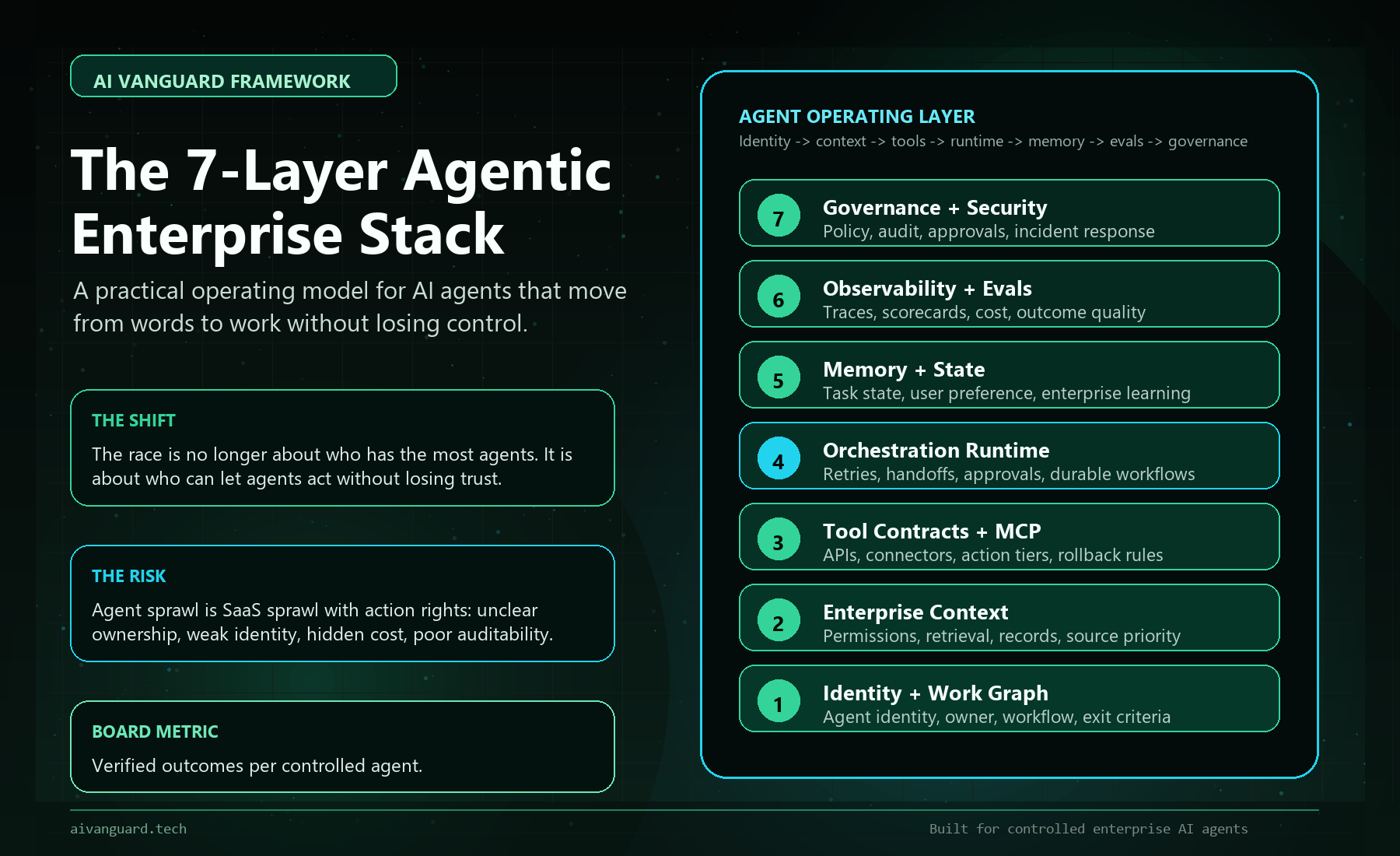
- Board-level metric: verified outcomes per controlled agent, not number of agents launched.
AI Vanguard Verdict
The AI agent market is becoming an operating-system market. The durable advantage is not the prettiest chatbot, the largest prompt library, or the longest vendor feature list. It is the controlled stack that lets agents access context, call tools, escalate decisions, produce audit evidence, and improve without creating agent sprawl.
Can this platform control agents across identity, context, tools, runtime, and audit?
High-volume, bounded, data-available, low-risk action set.
Verified outcomes per controlled agent.
The hottest AI topic in the enterprise is not another model benchmark. It is not whether one chatbot writes better emails than another chatbot. It is the rise of the agentic enterprise stack: the operating layer companies need before they can trust AI agents to do real work.
This matters because the market has shifted. In the last phase, executives asked whether generative AI could answer questions, summarize documents, write drafts, or generate code. In the current phase, executives are asking whether AI can actually move work through the business: update a record, resolve a customer issue, prepare a procurement decision, open a case, reconcile a data mismatch, trigger an approval, draft a contract deviation memo, or hand a clean exception package to a human operator.
That is a different problem. A chatbot can be impressive while staying harmless. An agent that touches customer data, financial records, logistics milestones, HR requests, developer environments, or security systems cannot be judged by a demo. It needs an operating system.
The enterprise AI race is shifting from model intelligence to operational control. The winner is not the company with the most agents. The winner is the company that can let agents act without losing trust.
AI Vanguard Framework
The 7-Layer Agentic Enterprise Stack
A responsive operating model for AI agents that move from words to work without losing control. Each layer has to be named, owned, tested, and observable before autonomy expands.
Why This Topic Is Hot Right Now
Several current signals point in the same direction. Microsoft framed the enterprise AI problem around the system surrounding agents: how they are built, contextualized, governed, observed, and improved over time. Google Cloud describes Gemini Enterprise as a secure platform where organizations can create, deploy, and govern agents, including Google-built, partner-built, and internally built agents. SAP announced Joule Studio for the full lifecycle of enterprise-scale agentic development, grounded in live business data and process semantics. AWS made its SAP MCP Server generally available on Amazon Bedrock AgentCore to connect AI agents to SAP ERP systems with identity, isolation, telemetry, and private connectivity. Zendesk is positioning customer service around an autonomous service workforce rather than old ticket deflection bots. The White House also placed advanced AI innovation and security in the same policy frame, with emphasis on cyber defense, critical infrastructure, secure model deployment, and industry collaboration.
The details differ, but the pattern is consistent: the enterprise conversation is no longer just, “Which model is smartest?” It is becoming, “What control layer lets AI perform work safely?”
That is why the phrase AI agent operating system is useful, even if it should not be taken literally as a desktop OS. In practice, this means the shared infrastructure, policies, runtime, and governance that allow many agents to operate across a company without becoming a security, compliance, cost, or data-quality mess.
The mistake many companies will make in 2026 is buying agent tools before designing the operating model. They will allow teams to spin up agents in silos, connect them to tools inconsistently, rely on weak permissions, and celebrate launch counts. Then they will discover that nobody can explain which agents exist, what they can access, which actions they performed, what they cost, what outcomes they produced, or who is accountable when they fail.
That is not transformation. That is a new form of shadow IT.
The Wrong Question: Which AI Agent Should We Buy?
Most enterprise buying conversations still start in the wrong place. A business team sees a demo. A vendor shows an agent that can answer questions, create a workflow, or perform a simple task. A pilot is approved. The team gets a fast win. Then another department repeats the pattern. Soon the company has one agent for sales, another for support, another for finance, another for HR, another for procurement, and several developer agents inside engineering.
At first, this looks like progress. Then the operational questions arrive.
- Who approved the data each agent can access?
- Can we revoke an agent’s permissions as easily as we revoke an employee’s?
- Do agents inherit source-level permissions or leak information across teams?
- What tools can each agent call, and under what conditions?
- Can an agent write to a system of record, or only prepare a draft?
- Where are agent actions logged?
- How do we test agents before they touch live workflows?
- Who reviews failures?
- How do we prove to legal, audit, or regulators that the agent followed policy?
- How do we prevent three agents from producing conflicting work on the same customer, shipment, invoice, ticket, or employee request?
These are not edge cases. They are the normal operating questions of a company that wants AI to move from experimentation to production.
That is why the better question is not which agent to buy. The better question is:
What enterprise stack lets agents act inside our business without breaking identity, data governance, workflow ownership, security, auditability, or customer trust?
This question changes the entire buying process. Instead of evaluating agents as isolated features, you evaluate the control plane, data layer, tool contracts, observability, governance model, and operating workflow that surround them.
The Definition: What Is an Agentic Enterprise Stack?
An agentic enterprise stack is the set of technical and organizational layers that allow AI agents to perform business work under control. It is not just an LLM. It is not just RAG. It is not just MCP. It is not just a workflow builder. It is not just a governance document. It is the full operating layer that connects the following capabilities:
- Identity: every human, agent, tool, system, and service account has a known identity and permission boundary.
- Context: agents can retrieve the right business facts from approved sources without violating access rules.
- Tools: agents can call APIs, applications, workflows, and connectors through explicit contracts.
- Orchestration: tasks can be planned, routed, paused, escalated, resumed, and completed across multiple systems.
- Memory: agents can preserve useful state without creating uncontrolled surveillance or stale context risk.
- Evaluation: behavior is tested before production and monitored continuously after release.
- Observability: leaders can see what agents are doing, what they cost, what failed, and what business outcomes changed.
- Governance: policies define what agents are allowed to know, say, decide, and execute.
- Security: sensitive actions are protected through least privilege, approvals, isolation, audit logs, and rollback paths.
The point is not to make the architecture sound complex. The point is to make the hidden complexity explicit before the organization scales. A single support agent answering FAQs might survive on a light stack. A fleet of agents touching orders, refunds, vendor data, finance records, HR information, and developer systems will not.
Chatbot Stack vs Agentic Enterprise Stack
| Dimension | Chatbot Stack | Agentic Enterprise Stack |
|---|---|---|
| Main function | Answer, summarize, route, draft | Plan, call tools, execute workflow steps, escalate, learn |
| Data model | Knowledge base or document retrieval | Live enterprise context with permissions and semantic grounding |
| Action model | Mostly read-only or conversational | Controlled tool access, workflow execution, system updates |
| Governance | Prompt rules and content filters | Identity, policy, approvals, logs, evals, lifecycle management |
| Success metric | Deflection, answer quality, user satisfaction | Verified outcomes, cycle time, risk reduction, cost per resolved work unit |
| Risk profile | Bad answer or poor customer experience | Bad action, data leak, policy breach, runaway cost, audit failure |
| Owner | Often CX, marketing, or a single business team | Shared ownership across business, IT, security, data, risk, and operations |
This table explains why many AI programs stall. They try to govern an action-taking agent with chatbot-era controls. That is like trying to run a payments system with a content moderation policy. The control model does not match the risk model.
The Seven Layers Every Enterprise Agent Program Needs
1. The Work Graph: Define the Work Before You Define the Agent
Agents do not create business value because they exist. They create value when they move a specific work unit from one state to another. That work unit might be a support ticket, procurement request, shipment exception, invoice discrepancy, customer onboarding case, sales research task, code review, compliance evidence request, or incident triage package.
The first layer is therefore not the model. It is the work graph. What is the job? What starts it? What data is required? What decisions are allowed? What tools are needed? What is the acceptable output? What triggers escalation? What counts as a verified resolution?
If you cannot draw the workflow, you should not automate it with agents. The agent will simply discover your operational ambiguity at machine speed.
A practical work graph has five parts:
- Trigger: the event that starts the work, such as a ticket, email, system alert, CRM update, or scheduled review.
- State: the current status of the work unit and the facts already known.
- Decision points: the places where judgment, policy, or data validation changes the next step.
- Actions: the tools or system updates the agent may perform, draft, or recommend.
- Exit criteria: the condition that proves the work was completed correctly.
This is where many companies should spend more time. A poorly mapped process becomes a poor agent, even if the model is excellent. A clear process can make a modest agent valuable because the boundaries are legible.
2. Identity and Permissions: Treat Agents Like Non-Human Workers
Every enterprise agent needs an identity. Not a vague API key. Not a shared admin credential. Not an invisible automation account. A real, governed non-human identity that can be provisioned, scoped, monitored, and revoked.
The reason is simple: an agent that can act is part of the workforce. It may not be a person, but it can access information, produce outputs, call tools, and trigger consequences. If the company cannot answer what the agent is, what it can access, who owns it, and when it should be deactivated, the agent is already a governance risk.
Good identity design includes:
- unique identities for each production agent;
- clear owner mapping to a business function and technical owner;
- least-privilege permissions by workflow, not broad department access;
- separation between read, draft, recommend, and execute permissions;
- time-bound elevated permissions for sensitive tasks;
- revocation workflows when a use case is retired;
- logs that distinguish human action from agent action.
The best mental model is employee access management plus service-account discipline. Agents should not inherit random human permissions. They should receive explicit permissions needed for the workflow and nothing more.
If an agent cannot be named, scoped, audited, and revoked, it should not touch production systems.
3. The Context Layer: Ground Agents in Business Reality
An agent without context is a fluent guesser. It may sound confident, but it does not understand your customer contracts, supplier terms, product catalog, data lineage, refund policy, compliance obligations, escalation rules, shipment milestones, employee entitlements, or account-specific exceptions.
The context layer is where enterprise AI becomes enterprise-specific. It connects agents to approved sources of truth while respecting access controls. In mature systems, this layer is not just a vector database. It combines retrieval, structured records, knowledge graphs, permissions, data freshness, semantic definitions, source ranking, and conflict detection.
The most important design question is not, “Can the agent retrieve documents?” It is, “Can the agent retrieve the right facts, from the right sources, for the right user, at the right time, with the right permission boundary?”
For example, a logistics agent should not only know general shipping terminology. It needs access to shipment status, carrier events, exception codes, customer SLAs, lane performance, customs documents, and escalation playbooks. A finance agent should not only summarize policies. It needs invoice metadata, purchase order terms, approval thresholds, vendor master data, and audit rules. A support agent should not only read help-center articles. It needs customer plan, order status, warranty terms, account history, and the latest policy version.
The context layer also needs conflict handling. Enterprise data is messy. Two systems may disagree. A policy page may be outdated. A CRM field may be incomplete. A knowledge base article may conflict with a contract. The agent should not silently choose whichever source happens to appear first. It should know source priority and flag uncertainty.
4. Tool Access and MCP: Connect Agents to Work Without Losing Control
The agentic moment becomes real when agents can use tools. That means calling APIs, querying databases, creating tickets, updating CRM records, drafting purchase requests, opening pull requests, changing workflows, invoking RPA bots, or triggering downstream automations.
Tool access is where the Model Context Protocol and similar connector standards become strategically important. MCP can reduce the chaos of one-off integrations by standardizing how agents discover and call tools. Recent moves around MCP in SAP, AWS, Zendesk, and broader agent ecosystems show why this layer is becoming a core enterprise concern.
But MCP is not a substitute for governance. It solves part of the connection problem. It does not automatically solve authorization, business approval, auditability, tool safety, prompt injection, data classification, exception handling, or rollback.
A serious tool layer defines:
- Tool contracts: what the tool does, what inputs it accepts, what outputs it returns, and what errors mean.
- Action tiers: read-only, draft, recommend, execute with approval, execute autonomously.
- Risk classes: low-risk actions like status lookup vs high-risk actions like refund, deletion, payment release, access grant, or production change.
- Approval gates: who approves which action class and under what conditions.
- Rate limits: how often agents can call a tool, especially expensive or sensitive systems.
- Rollback rules: what can be reversed automatically, what requires manual remediation, and what should never be autonomous.
The fastest path to agent failure is giving an agent a powerful tool and weak boundaries. The fastest path to useful autonomy is giving an agent a small number of well-specified tools inside a measured workflow.
5. Orchestration and Runtime: Agents Need a Place to Run
An enterprise agent is not just a prompt. It needs a runtime. The runtime handles sessions, task state, retries, timeouts, routing, dependencies, tool calls, approvals, escalations, and failure handling. This layer matters because real work is rarely a single turn.
A procurement agent may need to inspect a request, retrieve vendor data, compare contract terms, ask a human for missing information, wait for approval, create a draft order, log the decision, and hand the case to finance. A cyber triage agent may need to enrich an alert, check asset criticality, query logs, compare known indicators, create an incident summary, recommend containment, and escalate based on confidence and blast radius. A customer service agent may need to identify intent, verify identity, retrieve account history, check policy, propose action, execute a low-risk change, and monitor for customer satisfaction.
That cannot be managed cleanly with a single chat transcript. It requires orchestration.
The runtime should answer:
- What task is the agent working on?
- What step is complete?
- What data has been used?
- What tools were called?
- What approvals are pending?
- What happens if the model output is invalid?
- What happens if a downstream API fails?
- When should a human take over?
- How is the task resumed after a pause?
Enterprises should evaluate agent vendors and internal builds on runtime maturity, not just prompt quality. The difference between a demo and a production system often appears when something goes wrong.
6. Memory and Learning: Useful State Without Uncontrolled Risk
Memory is one of the most misunderstood parts of agentic AI. Vendors often present it as a feature: the agent remembers user preferences, prior work, past decisions, and contextual patterns. That can be valuable. It can also be dangerous if memory becomes an uncontrolled data layer.
Enterprise memory needs policy. What can be remembered? For how long? At what granularity? Can memory include personal data? Can it include confidential strategy? Can it include customer-specific exceptions? Can users inspect, correct, or delete it? Is memory shared across agents? Does it respect role-based access controls? Is memory stale after a policy changes?
A practical memory model separates three types of state:
- Task state: what is needed to complete the current workflow.
- User preference state: stable preferences that improve interaction quality.
- Organizational learning: aggregated insights about process bottlenecks, policy gaps, recurring failures, and improvement opportunities.
These should not be mixed casually. Task state may expire quickly. User preferences may require consent and privacy controls. Organizational learning should be aggregated and reviewed. Memory should increase reliability, not create a hidden database of sensitive context.
7. Observability, Evaluation, and Governance: The Difference Between Trust and Hope
The final layer is the trust layer: observability, evaluation, governance, and security. This is where the board, CIO, CISO, compliance team, operations leaders, and business owners can see whether agentic AI is working safely.
Observability should include more than logs. It should show task volume, tool calls, action types, error rates, cost per task, latency, human intervention rate, escalation quality, policy violations, retrieval source usage, approval time, and verified business outcomes.
Evaluation should happen before and after production. Before production, teams need test sets that reflect real edge cases, adversarial prompts, ambiguous records, policy conflicts, and low-confidence scenarios. After production, teams need continuous measurement against outcomes, not just model scores.
Governance should be practical. Long policy documents are not enough. Governance must become executable controls: permission rules, approval flows, blocked actions, required citations, model routing rules, data classification checks, audit logs, incident response procedures, and retirement criteria for agents that underperform.
The core question is: can the company explain and defend what the agent did?
If the answer is no, the agent is not production-ready. It may still be useful in draft mode. It may still assist humans. But it should not operate autonomously across business-critical workflows.
The New Buying Framework: What To Ask Vendors
Most vendor evaluations still overweight the demo. A better evaluation should score the whole stack. Here are the questions enterprise buyers should ask before approving an agent platform, agent builder, or managed agent service.
Identity and Access
- Can every agent have a unique non-human identity?
- Can agent access be scoped by workflow, data source, action type, and user role?
- Can we revoke, suspend, or rotate an agent identity centrally?
- Does the platform distinguish human actions from agent actions in logs?
Data and Context
- Does retrieval respect source-level permissions?
- Can the agent combine structured records and unstructured documents?
- How does the system handle conflicting sources?
- Can we define source priority and freshness rules?
- Can users see where an answer or decision came from?
Tools and Actions
- Can actions be separated into read, draft, recommend, approval-required, and autonomous tiers?
- Can high-risk actions be blocked or require explicit approval?
- Are tool calls validated against schemas?
- Are tool failures observable and recoverable?
- Can we use MCP or other standards without losing policy control?
Runtime and Orchestration
- Can workflows pause, wait for humans, and resume safely?
- Can tasks be reassigned when the agent is uncertain?
- Does the runtime support retries, timeouts, and rollback?
- Can multiple agents coordinate without conflicting actions?
Evaluation and Governance
- Can we run offline evaluations before production?
- Can we monitor production behavior continuously?
- Can we define policy tests for regulated workflows?
- Can we export audit evidence?
- Can we measure verified outcomes instead of only interactions?
A vendor that cannot answer these questions may still be useful for a narrow use case. But it should not be treated as the enterprise agent operating layer.
Where The Big Platforms Fit
The market is not moving in one direction. It is splitting into several layers that may coexist inside the same company.
Microsoft is pushing an integrated enterprise system around agents, work context, security, governance, developer workflow, and productivity surfaces. For companies already deeply invested in Microsoft 365, Entra, Defender, Purview, GitHub, Fabric, and Azure, this creates a natural control-plane conversation.
Google Cloud is emphasizing centralized visibility and control across Google-made, custom, and partner-made agents, along with open agent interoperability through A2A and a broader Gemini Enterprise platform. For companies focused on data, analytics, and multi-agent discovery, this is a significant strategic direction.
SAP is taking the enterprise process route. Joule Studio matters because SAP workflows sit close to finance, procurement, supply chain, HR, manufacturing, and operations. The ability to ground agents in business semantics and process context is more important than general chat quality in these environments.
AWS is important because enterprise agents need infrastructure, runtime, identity, and connectors into systems like SAP. The AWS for SAP MCP Server on Bedrock AgentCore is an example of the tool-access layer becoming industrialized, not handcrafted one integration at a time.
Zendesk shows how vertical platforms will turn agentic AI into domain-specific operating systems. In customer and employee service, the winning pattern is not a generic bot. It is data, knowledge, workflow, quality measurement, action flows, and outcome verification wrapped around service operations.
The practical conclusion: most enterprises will not have one agent platform. They will have a small number of strategic operating layers, plus domain platforms where the workflow depth is strongest. The architecture challenge is making those layers interoperable, governed, and visible.
Platform Signal Map: What The Major Players Are Really Building
The useful way to read the current platform race is not as a generic vendor comparison. It is a signal map. Each major platform is emphasizing a different part of the agentic enterprise stack, and serious buyers should use those differences to decide what belongs in the enterprise control layer versus a domain-specific application layer.
| Platform signal | Where it is strongest | What buyers should test |
|---|---|---|
| Microsoft | Work context, identity, security, productivity surfaces, developer workflow, and enterprise governance. | Can the agent registry, permissioning, Microsoft 365 context, security controls, and audit model cover cross-functional work without creating invisible automation? |
| Google Cloud | Agent discovery, custom and partner agents, data/analytics context, interoperability, and centralized control. | Can business teams build useful agents while central IT still governs identity, source access, tool use, and evaluation? |
| SAP | Business process semantics, ERP context, finance/procurement/supply-chain workflows, and process-grounded agents. | Can agents reason over live business objects and process rules without bypassing enterprise controls? |
| AWS | Runtime, infrastructure, managed connectors, SAP MCP access, private connectivity, telemetry, and scalable deployment. | Can the runtime isolate agents, log tool calls, enforce identity, and support production-grade workflows across critical systems? |
| Zendesk | Customer and employee service workflows, resolution quality, knowledge, action flows, and domain-specific automation. | Can the platform prove true resolution, escalation quality, and customer trust instead of only deflection? |
The Board-Level Risk: Agent Sprawl
Agent sprawl is the 2026 version of SaaS sprawl, but with higher risk. SaaS sprawl meant too many tools, duplicated spend, weak procurement, and scattered data. Agent sprawl means too many autonomous or semi-autonomous workers with unclear permissions, inconsistent quality, and limited oversight.
The warning signs are easy to spot:
- multiple teams launching agents without a central registry;
- agents connected to tools through shared credentials;
- no standard policy for agent approval or retirement;
- no consistent evaluation before production;
- no separation between draft mode and execution mode;
- no cost attribution by agent or workflow;
- no owner for agent failures;
- no source-level permission enforcement;
- no incident playbook for harmful agent action;
- success measured by adoption instead of verified outcomes.
Agent sprawl will be tempting because every team will want speed. The CIO and COO should not block experimentation, but they should require minimum controls. The goal is not bureaucracy. The goal is to prevent dozens of small experiments from becoming an invisible operational risk.
Autonomy without a registry is not innovation. It is unmanaged labor.
The 90-Day Roadmap To Build The First Agentic Stack
The best way to start is not by creating a giant enterprise AI program. It is by selecting one workflow and building the minimum operating stack around it. The stack can then become the template for future agents.
Days 1-15: Pick The Workflow and Map The Work
Choose a workflow with high volume, clear business pain, available data, and bounded actions. Avoid the most politically sensitive or compliance-heavy workflow as the first test. Good candidates include customer status resolution, internal IT request triage, invoice exception preparation, sales account research, shipment exception analysis, policy lookup with draft response, or compliance evidence collection.
Write the work graph. Define trigger, input data, allowed sources, decision points, action tiers, escalation rules, and verified outcome. Do not start by selecting a model. Start by defining the job.
Days 16-30: Build The Control Baseline
Create the agent identity. Define owners. Connect only the minimum required data sources. Create explicit tool contracts. Separate read-only, draft, approval-required, and autonomous permissions. Build a small evaluation set from real historical cases. Define failure categories and escalation rules.
At this stage, the agent should not be autonomous. It should operate in shadow mode or draft mode. The point is to see whether it can reason through real work before it acts.
Days 31-50: Run Shadow Mode Against Real Cases
Let the agent process real incoming work without executing actions. Compare its proposed outputs against human decisions. Measure accuracy, source usage, hallucination rate, policy adherence, escalation quality, latency, and cost per case.
This phase exposes the truth. You will learn whether the data is clean, whether policies are clear, whether the model understands the workflow, whether retrieval is reliable, and whether the human team trusts the output.
Days 51-70: Allow Supervised Execution
Move the agent from draft mode to supervised execution on low-risk action tiers. For example, it may update a non-critical field, create a draft ticket, prepare a response for approval, attach evidence, or trigger a workflow that still requires human sign-off.
Instrument everything. Log tool calls, approval decisions, errors, overrides, user feedback, and final outcomes. Create a weekly review rhythm with business, IT, risk, and operations owners.
Days 71-90: Expand Only Where The Evidence Supports It
Do not expand because the demo looks good. Expand because the measured evidence supports it. If the agent performs reliably on a narrow workflow, widen the action set slightly. If it fails on edge cases, tighten context, rewrite policies, improve retrieval, add approval gates, or keep the agent in assistant mode.
At the end of 90 days, the deliverable should not just be a working agent. It should be a reusable operating pattern: identity model, context design, tool contract template, evaluation framework, dashboard, approval policy, and incident playbook.
Reader Checklist
Agentic Enterprise Stack: 90-Day Control Checklist
Use this one-page checklist before moving an AI agent from assistant mode into supervised or autonomous execution. It covers identity, context, tool contracts, runtime, memory, observability, and governance gates.
The Metrics That Actually Matter
Bad AI programs report vanity metrics. They count agents launched, prompts used, users onboarded, messages sent, or documents summarized. These metrics may be useful operationally, but they do not prove business value.
An agentic enterprise stack should measure outcomes.
| Metric | Why It Matters |
|---|---|
| Verified outcome rate | Shows how often the agent completed the intended work correctly. |
| Human override rate | Shows where the agent is useful but not yet trusted. |
| Escalation precision | Shows whether the agent knows when not to act. |
| Cost per resolved work unit | Links model, runtime, and human review cost to real output. |
| Cycle-time reduction | Measures whether work moves faster, not just whether AI was used. |
| Policy violation rate | Tracks control failures before they become incidents. |
| Tool-call error rate | Shows integration and runtime reliability. |
| Source citation quality | Measures whether decisions are grounded in approved sources. |
| Exception package quality | Shows whether human escalations arrive with useful context. |
| Agent retirement rate | Shows whether the company is willing to kill weak agents instead of accumulating clutter. |
The most underrated metric is escalation quality. A good agent does not have to solve everything. It must know when to stop, explain why, package the case cleanly, and hand it to the right human with the right evidence. That alone can create major productivity gains in complex operations.
What This Means For CIOs, COOs, and AI Leaders
The CIO should treat agents as a new class of digital worker requiring identity, lifecycle management, security, and observability. The COO should treat agents as operational capacity that must be mapped to process outcomes, not as generic productivity software. The CISO should treat agents as privileged actors that can become attack surfaces if tool access, prompt injection, data exfiltration, and permission boundaries are not controlled. The data leader should treat agents as consumers of enterprise context that require source quality, semantic clarity, and lineage. The business owner should treat agents as process redesign opportunities, not simply automation shortcuts.
The companies that win will not necessarily be the first to deploy the most agents. They will be the first to create a reliable system for deciding which agents deserve autonomy, which should remain copilots, which should be retired, and which need better data or process design before launch.
There is a simple test for readiness: can a senior executive ask for the list of all production agents and receive a credible answer within one hour? The answer should include owner, purpose, permissions, connected systems, action tiers, latest evaluation results, monthly cost, incident history, and business outcomes.
If that list does not exist, the company does not yet have an agentic enterprise stack. It has experiments.
Common Failure Modes
Failure 1: The Agent Has No Clear Job
Teams often create agents around capabilities instead of work. The agent can summarize, search, draft, and answer. But what outcome does it own? What work unit does it move? What business metric changes? Without a clear job, the agent becomes a novelty tool.
Failure 2: The Agent Uses Data It Should Not See
This can happen when retrieval is connected broadly or when agents inherit permissions from users without enough source-level control. The fix is explicit permission design, sensitive-source classification, and audit logs that prove what was accessed.
Failure 3: The Agent Can Act But Cannot Explain
Executives will not trust agents that make opaque decisions. Regulated organizations will not be able to defend them. Every material action should have a trace: source facts, policy logic, tool calls, confidence, and approval history.
Failure 4: The Agent Is Measured Like A Chatbot
Deflection, interaction volume, and user satisfaction are not enough for action-taking agents. Measure verified work completion, human override, policy adherence, and cost per outcome.
Failure 5: The Agent Never Gets Retired
Companies are good at launching tools and bad at killing them. Agents should have retirement criteria. If an agent produces weak outcomes, costs too much, creates excessive escalations, or depends on broken data, pause it until the root cause is fixed.
The Strategic Bottom Line
The next enterprise AI wave will not be won by model access alone. Models will keep improving, but the hardest work is shifting to the operating layer: context, control, workflow, observability, security, and governance.
This is good news for serious operators. It means AI advantage will not belong only to companies with the largest model budgets. It will belong to companies that understand their processes, clean their data boundaries, design tool contracts, measure outcomes, and build governance into execution instead of adding it after the incident.
The agentic enterprise stack is not a luxury architecture. It is the practical foundation for letting AI move from words to work.
The question is no longer whether AI can act. The question is whether your enterprise is ready to let it act without losing control.
Executive Checklist
- Create a central registry of all production and pilot agents.
- Assign a business owner and technical owner to each agent.
- Define the work graph before deploying the agent.
- Separate read, draft, recommend, approval-required, and autonomous permissions.
- Use source-level access controls for enterprise context.
- Define tool contracts and risk tiers before enabling action.
- Run shadow mode on real cases before execution.
- Measure verified outcomes, not launch counts.
- Instrument tool calls, cost, errors, escalation, and policy violations.
- Create retirement criteria for weak or risky agents.
FAQ
What is an agentic enterprise stack?
An agentic enterprise stack is the operating layer that lets AI agents perform business work safely. It combines identity, permissions, enterprise context, tool access, orchestration, memory, observability, evaluation, governance, and security into one managed architecture.
How is an AI agent operating system different from a chatbot platform?
A chatbot platform mainly answers questions or routes conversations. An AI agent operating system governs agents that can plan, call tools, access enterprise data, execute workflow steps, request approvals, remember state, and produce auditable outcomes across departments.
Who should own enterprise AI agents?
Ownership should be shared. Business units own outcomes and process design. IT owns identity, integration, security, and reliability. Risk and legal own policy boundaries. Data teams own context quality. The mistake is letting one function deploy agents without the operating controls of the others.
What should companies build before deploying autonomous AI agents?
Before autonomy, companies need a narrow workflow map, source-level permissions, approved tool contracts, an evaluation set, escalation rules, observability, rollback paths, and named human owners for exceptions. Autonomy should expand only after measured performance in shadow or assisted mode.
Is MCP enough to make AI agents enterprise-ready?
No. MCP can make tool access easier, but enterprise readiness also requires identity, authorization, data governance, audit trails, telemetry, testing, lifecycle management, human approvals, and policy enforcement. MCP is a connector layer, not the whole operating model.
What is the fastest safe way to start with enterprise AI agents?
Start with one high-volume, bounded workflow where the data is available and the action risk is low. Run the agent in read-only or draft mode first, measure precision, escalation quality, cost per outcome, and cycle-time reduction, then allow supervised execution on a limited action set.
Related AI Vanguard Research
- AI Agent Control Plane: The 2026 Architecture for Enterprise Agents That Do Real Work
- The Agentic Data Layer: Why Enterprise AI Transformation Fails Without Data Control
- Enterprise AI Governance Framework 2026
- RAG in Production 2026: Enterprise Guide
- Contact Center AI Production Architecture
- The Freight Forwarding Integration Layer
Sources and Market Signals
- Microsoft, June 2, 2026: enterprise AI framed around a governed system for building, contextualizing, running, governing, and improving agents.
- Microsoft, March 9, 2026: Agent 365 and the Frontier Suite position agent governance and work context as enterprise controls.
- Google Cloud Gemini Enterprise Agents: centralized visibility and control for Google-built, partner-built, and custom agents, with emphasis on governance and interoperability.
- SAP Joule Studio, May 2026: enterprise-scale agent lifecycle, live business data grounding, orchestration, runtime, observability, and memory.
- AWS for SAP MCP Server, May 2026: MCP-based access for AI agents into SAP ERP with identity, isolation, telemetry, and managed runtime.
- Zendesk Relate 2026: autonomous service workforce, platform-level governance, MCP support, quality measurement, and outcome-based resolution.
- White House Executive Order, June 2, 2026: advanced AI innovation and security framed around cyber defense, critical infrastructure, secure deployment, and industry collaboration.
Implementation detail: build the evidence layer with this AI agent observability field guide.
Research Path