Run your first AI pilot in 90 days.

Choose one task, test it with your team, and decide what to scale. Start with the completed example below.

Free Digital Operating System Playbook · 135 pages

Digital Operating System — AI Vanguard’s practical guide to your first AI pilot
The complete 135-page guide to AI adoption, governance and measurement.

Start today with one task

  1. Choose a task. Pick something repetitive your team already does, such as answering a delivery question.
  2. Time five examples. Record how long they take today and what a correct result looks like.
  3. Name one owner. Agree who will review the trial before you introduce an AI tool.

Five examples give you a first look. The completed plan below shows how to collect a larger starting sample.

A completed pilot plan you can copy

Example scenario with illustrative numbers. Use your own measurements before making a decision.

Help a support team draft replies to delivery questions

AI prepares a draft using approved delivery information. A person checks and sends every reply.

Try it on
100 routine delivery replies a week. A person checks and sends every reply.
Who owns it
The support lead, with a review every Friday.
Time target
From 8 minutes to 6 minutes per reply, including human review.
Quality checks
Audit 50 replies each week. Check delivery promises and whether customers need to contact you again.
When to expand
Only after two consecutive weeks meeting both the time and quality checks.
Read the full plan, checks, and 90-day schedule
The task
Draft replies for 100 routine delivery questions each week. Keep refunds, complaints, and unusual cases with the existing team.
The owner
The support lead runs the pilot and reviews the results every Friday.
The starting point
Time 50 comparable replies before the pilot and record how often a customer contacts you again about the same issue within 7 days. This example starts at 8 minutes per reply, including review.
The target
Bring the average down to 6 minutes, including human review, while maintaining reply accuracy.
The data and checks
Use approved delivery policies and only the order details needed for the reply. A person checks the order status, delivery promise, and recipient before sending.
The decision
Expand only after two consecutive weeks at 6 minutes or less, no incorrect delivery promises in a 50-reply weekly audit, and no increase in repeat contacts. If those checks fail, fix the process and retest.

90-day schedule and time calculation

  1. Days 1–14. Name the owner, time the 50 starting replies, record the repeat-contact rate, approve data access, and agree on the checks.
  2. Days 15–60. Try up to 100 eligible replies a week. Keep human approval on every reply and audit 50 each Friday.
  3. Days 61–90. Compare time, accuracy, repeat contacts, and tool costs. Decide whether to expand, change the process, or stop.

What the target would mean. Saving 2 minutes on 100 replies frees 200 minutes, or 3 hours 20 minutes, each week. Track how that capacity is used and include tool costs in the decision.

Copies the complete plan, including the detailed checks and schedule.

To use this plan, replace the task, owner, starting measurement, and decision thresholds with your own.

What happened in a real support operation?

A published study of 5,172 customer-support agents

Erik Brynjolfsson, Danielle Li, and Lindsey Raymond studied the introduction of an AI assistant at a business-software company. Their 2025 Quarterly Journal of Economics paper reports a 15% average increase in issues resolved per hour.

Benefits varied. Less experienced workers gained more, while the most skilled workers saw small declines in conversation quality. Agents retained control of their replies.

What to take into your pilot. Measure quality as well as speed, and compare results across experience levels. Use your own baseline to judge the outcome.

Published research case, checked 7 November 2026. Read the study and its limitations

Now check your own idea

Six questions from the Playbook’s readiness test, page 41 of the PDF.

Open the six-question checklist
What workflow changes?
One named workflow
Who owns it?
One accountable owner
What metric improves?
One primary KPI
What data is needed?
Named sources and owners
What risk exists?
Controls and escalation path
What happens by day 90?
Scale, stop, or redesign decision

Before you fund a pilot

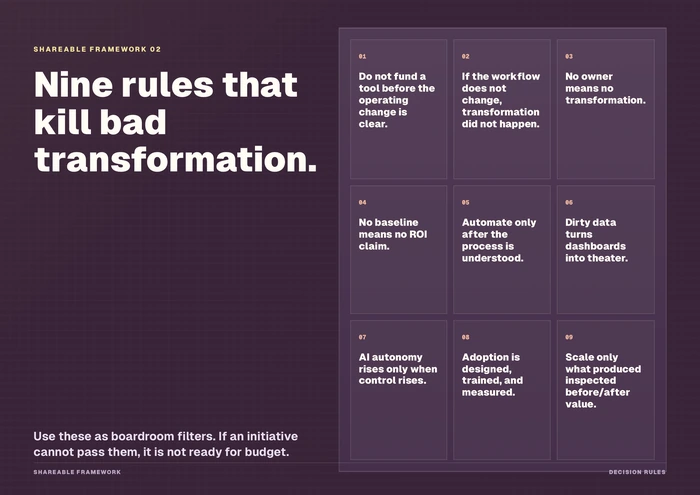
Four of the nine decision rules on page 11 of the guide, shown here in readable text.

  • Do not fund a tool before the operating change is clear.
  • No owner means no transformation.
  • No baseline means no ROI claim.
  • Scale only what produced inspected before/after value.
Read all nine decision rules

Get the full guide

The full Playbook covers workflow selection, controls, measurement, and the decision to scale.

What’s inside

Find the right work

Use the maturity ladder, workflow audit and department examples to pick a problem worth solving.

Set controls before launch

Decide who owns the workflow, where people must approve actions, and what to log.

Make the case to scale

Set a baseline, measure a 90-day pilot and use the ROI model to decide what happens next.

Preview the guide

Open a preview to read the text. You can also expand the original designed page to zoom and move around it, then return to the guide.
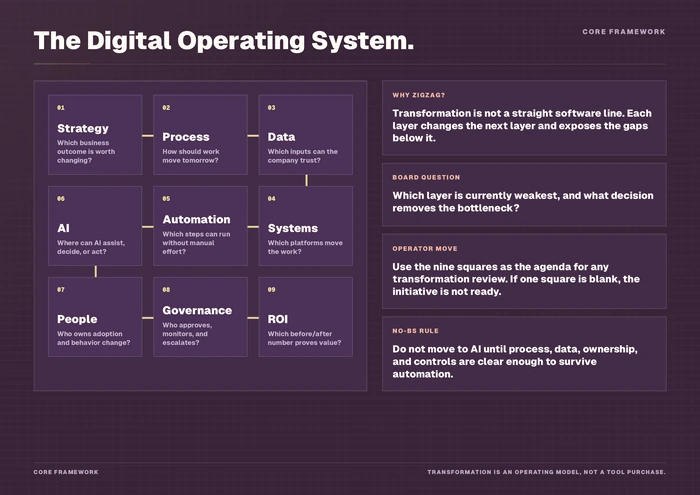
Preview of the Digital Operating System framework
The operating system frameworkPage 6 of the full guide
Read the preview
Preview of the decision rules
Decision rules for leadersPage 11 of the full guide
Read the preview
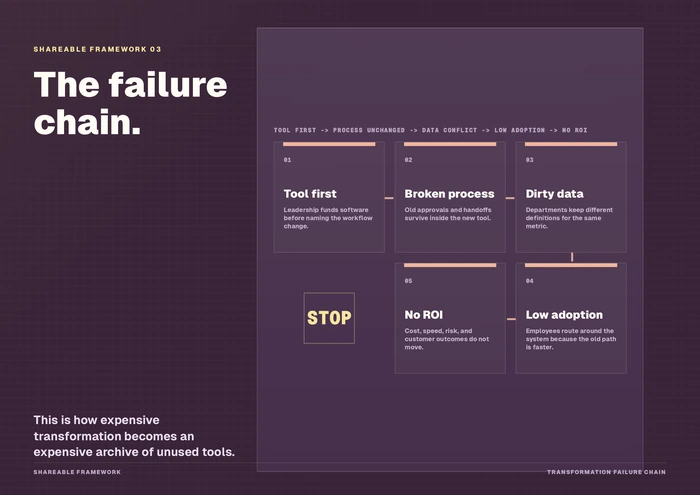
Preview of the failure chain
Where transformation breaks downPage 12 of the full guide
Read the preview