The operator’s field guide · Researched 20 October 2026
The value appears when the right goods arrive—and the economics work.
A buyer places an order. A supplier confirms it. A critical line never arrives. The buyer discovers the gap late, searches again, misses another minimum order and calls Support. A marketplace can report a successful conversion while everyone involved has a worse day.
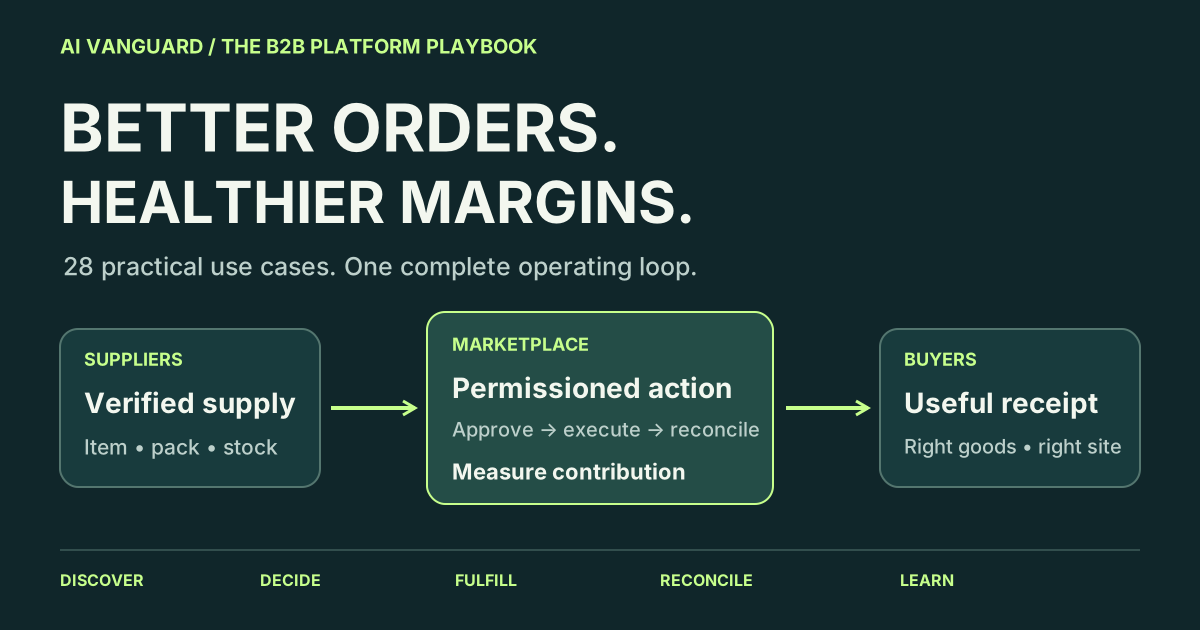
AI for B2B marketplaces is most useful when it turns fragmented demand, catalog, inventory and order information into a verified next action. That can mean a better supplier shortlist, an earlier warning, a buyer-approved recovery order or a correctly reconciled invoice. Its value depends on the completed business outcome, permissions and full cost.
The two-minute operator brief
What should a B2B marketplace automate first?
Start with one expensive, repeated failure you can verify from request to receipt. Give AI the job of assembling evidence and preparing the next action. Keep item identity, purchasing limits and execution permissions in enforceable rules. Expand only when the workflow improves completed orders and contribution after full costs.
- 01 · Find the failure
Trace difficult orders. Separate bad data, missing ownership and integration gaps from tasks that actually need AI.
Choose your first workflow → - 02 · Make it executable
Define the evidence, owner, approval and stop conditions for one bounded decision.
Inspect a worked decision packet → - 03 · Test the economics
Count incremental completed trade, then subtract review, tools and servicing costs. Keep released hours separate from cash.
Change the assumptions →
The useful surprise: this playbook’s synthetic example releases 216.7 handling hours a month while producing −$552 monthly contribution. Faster work and a viable business case are different tests.
This playbook is for platforms connecting business buyers with suppliers: wholesale exchanges, industrial procurement networks, food-service platforms, specialist distribution, multi-site purchasing and marketplaces with embedded inventory software. Regulated goods require additional eligibility and professional controls. Examples below are synthetic; they are not results from a named company or a private client study.
Choose the first problem you can actually solve
If you run a supplier–buyer platform, begin by following a few difficult orders from the original request to receipt and financial closure. Watch where people retype information, wait for confirmation, lose ownership or make decisions with stale records. Then ask whether fixing the problem needs AI, a better integration, a business rule or an accountable person.
| What you observe | First intervention | Where AI helps | Proof of value |
|---|---|---|---|
| Wrong packs or duplicate catalog items | Establish item identity and units | Extract and propose mappings for review | Correct matches and fewer order corrections |
| Accepted orders arrive short | Reconcile original commitments and stock signals | Detect risk and prepare eligible recovery options | Additional complete, timely receipts after full costs |
| Accounts launch but do not use the workflow | Define successful real work and an owner | Find adoption blockers and guide the next task | Repeated successful workflow use, not logins |
| Support and disputes keep returning | Link cases to orders and unresolved causes | Assemble evidence and suggest the next accountable action | Durable resolution without credits or errors rising |
| Revenue grows while cash deteriorates | Separate order value, revenue, margin and collections | Find leakage and prioritize legitimate reconciliation | Collected contribution and lower unresolved exposure |
A shortage-recovery pilot is a strong candidate when the platform has enough eligible cases, trustworthy order state, alternative supply and a clear purchasing authority. It is a poor candidate when shortages are rare, stock cannot be confirmed or every alternative requires a different commercial contract. Choose the workflow your evidence supports; the example later is a method, not a universal priority.
Understand who pays before deciding what to automate
The person clicking the screen may not be the paying customer. A branch employee can use inventory software funded by a head office. Suppliers may fund marketplace commissions or subscriptions while buyers drive transaction demand. A hospital procurement team may use a platform whose implementation and support are paid through an enterprise contract.
Map the payer, user, beneficiary, approver and operator for each offering. They often differ. A feature that reduces buyer effort may increase supplier administration; a supplier promotion may make the platform more money while making a buyer’s basket worse. Those tradeoffs belong in the product decision.
Use the financial terms consistently: gross merchandise value (GMV) measures the value of trade passing through the platform; monthly recurring revenue (MRR) measures qualifying contracted recurring revenue. Identify the applicable fees and costs before translating either measure into contribution.
| Revenue engine | Commercial unit | Useful AI outcome | Economic trap |
|---|---|---|---|
| Transaction marketplace | Applicable commission or fee on eligible trade | More genuine fulfilled trade with tolerable servicing cost | Counting all GMV as platform revenue |
| Embedded software | Contracted recurring subscription | Faster successful adoption, sustained use, justified paid expansion | Counting a technical go-live as customer value |
| Supplier services and promotion | Subscription, service or clearly labeled sponsored placement | Qualified demand and better catalog execution | Hiding paid influence inside a supposedly neutral recommendation |
| Implementation, payments or credit services | Contract-specific fee or net contribution after delivery and risk costs | Accurate setup, reconciliation, collections and controlled exceptions | Treating labor-heavy services or financing exposure as effortless software margin |
Validate these arrangements with actual contracts and Finance. Do not assume a marketplace owns inventory, acts as merchant of record, earns the displayed commission on every order or can change payment terms. Principal-versus-agent accounting and revenue recognition require the appropriate accounting judgment. The operating worksheet here does not decide that classification.
Give each order three connected records
Commercial commitment: what the buyer requested, what the supplier accepted, the original promised quantities, price, site and deadline. Preserve every revision rather than overwriting the original promise.
Physical execution: stock confirmation, reservation where supported, dispatch, receipt, quantity, damage and any required batch or expiry evidence. A shipping notification is evidence of dispatch; it is not proof of receipt.
Financial closure: invoice, receipt matching, credits, settlement, disputes and actual collection. A support ticket can close while money is still unreconciled.
Join those records using stable identifiers. GS1’s GTIN rules make clear why packaging and declared-content changes matter to trade-item identity. EPCIS 2.0 provides interfaces and representations for visibility events. Neither standard makes a supplier’s stock feed truthful or current. Your platform still needs provenance, validation and operational ownership.
What current evidence supports—and what remains unproven
Procurement assistance is already a concrete product category. Amazon’s November 2025 Business announcement described account configuration, purchasing guidance and spend-anomaly monitoring, with US access and plan boundaries. Alibaba’s AI Mode announcement described conversational sourcing and supplier comparison; it presented a planned rollout in December 2025. Its current Accio Work page markets broader sourcing and commerce workflows. These are attributed vendor capabilities and positioning, not independent proof of buyer savings or profitable autonomy.
The integration starting point is uneven. Eurostat’s May 2026 publication reports enterprise resource planning (ERP) use in 2025 among 41% of small EU enterprises versus 89% of large enterprises. Small means 10–49 people; large means 250 or more. The survey excludes microbusinesses and does not describe every region or industry. The operating implication is to support different supplier maturity levels instead of assuming everyone can provide a clean ERP API. Eurostat source and methodology.
Faster assistance can help people, but the measured setting matters. The revised Generative AI at Work paper analyzes 5,172 customer-support agents and reports an average 15% increase in issues resolved per hour, with different effects across experience and skill. That is evidence about assisted support work in its studied setting—not a forecast for marketplace fulfillment, total payroll or autonomous buying. Revised study, version 2.
Observed sales can conceal unmet demand. If an item was unavailable, zero sales do not establish zero demand. Research on the censored newsvendor problem formalizes information losses under specific assumptions. Preserve availability periods, substitutions and lost-order signals before training a replenishment model. A more fluent assistant cannot reconstruct facts that were never observed.
Use the right kind of intelligence for the decision
Language models are useful for messy descriptions, multilingual requests, document extraction, explanations and coordinating approved tools. Predictive models are useful for demand distributions, delay risk and anomaly ranking. Optimization chooses a feasible basket under constraints. Rules enforce non-negotiable permissions, budgets, identity and tolerances. Experienced operators resolve ambiguous commercial and safety decisions.
For example, an assistant can turn “find this pump with the right connection and delivery tomorrow” into structured requirements. Retrieval can find possible items. A matching process checks specifications. An optimizer compares eligible offers after delivery charges, minimum orders and split shipments. A policy service checks the buyer’s authority. A person approves where required. The order service commits the accepted decision and reconciles the result.
That separation makes the workflow inspectable. It also makes failures easier to diagnose: a bad specification match needs a different repair from a stale stock feed or a rejected payment. Avoid asking one unconstrained model to invent all three layers.
28 practical AI use cases across the platform
The following map is an opportunity inventory, not a backlog to launch simultaneously. Each workflow needs a measurable failure to fix, sufficient data and a human owner. “AI can prepare” does not imply “AI may commit.” The implementation detail and controls matter more than the number of agents.
Group 1: Establish trustworthy supply
Resolve product identity and packaging
When a supplier file or buyer item code cannot map to the catalog, AI compares approved identifiers, descriptions, pack sizes, and source documents. It proposes mappings and highlights conflicts; unresolved identity remains unresolved.
Decision rights: A catalog steward approves versioned mappings. AI cannot equate similar products or change packaging.
Measure: Audited mapping precision, unresolved backlog, ordering errors per mapped line.
Watch: Confusing cases with units or treating a related item as identical. Therapeutic similarity never establishes identity.
Detect stale inventory claims
When stock feeds are late, static, or contradicted by rejected orders, AI uses timestamps, reservations, feed incidents, and transaction outcomes to flag unreliable availability and prioritize confirmation.
Decision rights: The inventory operations lead owns freshness rules. Rules can expire unverified availability; AI cannot invent quantity or remove a hold.
Measure: False-availability rate, fresh-stock coverage, rejections caused by stale data.
Watch: Penalizing a small supplier for sparse updates when its documented confirmation process works reliably.
Estimate supplier promise reliability
Before accepting a quote, use promised, accepted, and delivered quantities alongside item, branch, lane, order size, and lead time. AI estimates fulfillment probability and delivery uncertainty for that context.
Decision rights: Procurement operations selects suppliers under published policy. Suppliers can challenge inaccurate evidence.
Measure: Prediction calibration, on-time-in-full delivery, failed promises following overrides.
Watch: Historical incumbents receiving every attractive order while new suppliers never gain enough evidence to compete.
Map concentration and disruption exposure
During procurement reviews or supplier disruption, AI links fulfilled demand, viable alternatives, upstream dependencies, lead times, and credit exposure. It models what demand becomes unserviceable if a critical source fails.
Decision rights: The procurement head approves supplier qualification, allocation changes, and negotiations.
Measure: Critical demand and contribution exposed to one viable source; time to qualify alternatives.
Watch: Counting several distributors of the same upstream source as genuinely diversified supply.
Group 2: Protect order completion
Recover a missing order line
A rejection or partial fulfillment opens a recovery case. AI compares confirmed alternative supply for the same approved item and packaging, deadline, landed cost, and expected contribution.
Decision rights: A recovery specialist prepares options; the authorized buyer approves changed supplier or spend. A separate executor commits the approved version.
Measure: Incremental accepted demand and contribution, wrong-item rate, duplicate commitments.
Watch: Claiming recovery for demand that would have been fulfilled anyway. No therapeutic substitution.
Consolidate sourcing and freight
For a multi-line basket, combine verified stock, exact matches, minimum orders, freight thresholds, cut-off times, and acceptance likelihood. AI explains a few feasible sourcing plans and their trade-offs.
Decision rights: Buyer procurement chooses a plan. Purchase orders require current confirmation and delegated authority.
Measure: Buyer landed cost, basket contribution, complete on-time delivery, extra shipments.
Watch: A cheap-looking basket that increases receiving work, fragments delivery, or depends on unreliable supply.
Triage fulfillment exceptions
When a shipment misses a milestone, AI combines supplier acknowledgements, warehouse events, tracking, deadlines, and capacity. It prioritizes cases, identifies evidence gaps, and drafts a factual update.
Decision rights: The fulfillment supervisor assigns work and approves communications, expedites, or carrier changes.
Measure: Preventable late lines, time to verified resolution, contacts per exception.
Watch: Fabricated delivery estimates or closing an alert before the underlying obligation is resolved.
Assemble shortage and dispute evidence
When a buyer reports missing, damaged, or mismatched goods, AI assembles order versions, delivery records, photos, invoice lines, and permitted correspondence into a source-linked timeline with contradictions visible.
Decision rights: The dispute lead decides liability and settlement; finance approves credits.
Measure: Time to verified settlement, repeated disputes, leakage, overturned decisions.
Watch: Treating extracted text or a photograph as conclusive proof. AI cannot declare fraud or issue a refund.
Group 3: Plan inventory without moving the risk
Prepare useful buyer reorders
Near an established ordering interval or approved stock trigger, AI uses purchasing history, seasonality, outstanding orders, branch stock, and budgets to propose a reorder with uncertainty and reasons.
Decision rights: The buyer's inventory manager approves quantities. A reminder does not authorize automatic purchasing.
Measure: Avoidable stockouts, inventory days, useful accepted proposals, buyer net benefit.
Watch: Treating a promotional spike or emergency purchase as continuing demand and creating excess stock.
Evaluate branch transfers
When one branch is short and another appears overstocked, AI compares buyer-owned stock, reservations, ownership rules, local demand, transport cost, and deadlines to propose a feasible transfer.
Decision rights: The regional inventory owner approves release and receipt; branch managers confirm physical stock.
Measure: Net stockouts avoided, donor shortages caused, transfer cost, accepted stock.
Watch: Solving one branch's shortage by creating another, or assuming transfers across legal entities are permitted.
Advise supplier replenishment
For an opted-in supplier, AI combines consented demand, current stock, open orders, lead times, and forecast errors. It presents demand ranges and replenishment scenarios with overstock and shortage risk.
Decision rights: The supplier's planner owns upstream purchasing. The marketplace cannot place orders or disclose confidential buyer demand.
Measure: Supplier fill rate, forecast calibration, inventory exposure, contribution.
Watch: Treating marketplace demand as the supplier's entire market or synchronizing orders into new volatility.
Route aging stock transparently
When verified inventory approaches an aging threshold, AI matches lot and expiry evidence, buyer acceptance rules, storage needs, consumption horizon, and allowed terms to eligible demand.
Decision rights: Supplier inventory management approves terms; buyer procurement explicitly accepts the stated condition.
Measure: Accepted sell-through net of returns, supplier contribution, buyer waste.
Watch: Moving waste risk to buyers and calling it efficiency. No concealed remaining shelf life or unauthorized discount.
Group 4: Convert onboarding into durable value
Check supplier operating readiness
When a supplier joins or changes scope, AI extracts documents, catalog fields, service areas, terms, feed capabilities, and test results into an evidence-linked readiness checklist.
Decision rights: Supplier operations approves readiness; qualified reviewers handle eligibility and financial checks.
Measure: Time to first correctly fulfilled transaction, rework, early failure rate.
Watch: Celebrating sign-ups while order acknowledgement, stock updates, invoicing, and support ownership remain unresolved. AI cannot certify a supplier from text alone.
Diagnose supplier activation barriers
When an onboarded supplier does not fulfill repeat demand, AI examines feed health, feasible opportunities, pricing, responses, funnel events, and interviews. It proposes a testable barrier and next action.
Decision rights: The supplier success lead owns a dated plan; engineering and commercial owners accept their tasks.
Measure: Repeated correctly fulfilled orders and supplier contribution.
Watch: Blaming adoption when the platform sends unattractive demand, lacks qualified buyers, or has broken integration.
Unblock buyer workflow adoption
When configured users or branches do not complete purchasing workflows, AI combines role-based funnel events, permissions, integration errors, training records, and interviews to distinguish access, supply, approval, and usability barriers.
Decision rights: Buyer success coordinates with the buyer's process owner; the payer approves policy or scope changes.
Measure: Eligible users completing repeated end-to-end workflows, exception burden, buyer value.
Watch: Chasing daily activity in an infrequent purchasing process or bypassing legitimate approvals.
Prove value to the actual payer
Before renewal, AI combines the contract, payer priorities, promised outcomes, usage, validated purchasing comparisons, and unresolved failures. It separates verified cash savings, released time, service improvements, and estimates.
Decision rights: The account director and buyer sponsor validate evidence; commercial leadership approves terms.
Measure: Payer-accepted outcomes, retained contribution, renewal quality.
Watch: Mistaking a daily user's convenience for the outcome the budget owner agreed to fund.
Group 5: Grow contribution and collect the cash
Expand proven existing accounts
After current scope demonstrates value, AI evaluates eligible branches, categories, supply coverage, contractual rights, payer priorities, and implementation capacity. It proposes expansion with dependencies, workload, and contribution assumptions.
Decision rights: The account director proposes; the buyer sponsor approves scope and access; delivery leadership commits capacity.
Measure: Realized incremental contribution, profitable active branches, post-expansion service.
Watch: Recording recurring revenue while custom integration and support consume the economic gain.
Recover lapsed buyer relationships
When purchasing moves outside normal cadence, AI considers seasonality, service failures, supply coverage, pricing, feedback, and contract status. It proposes evidence-backed causes and a practical recovery action.
Decision rights: The account owner validates context and authorizes outreach. Concessions require separate approval.
Measure: Sustained repeat purchasing and retained contribution after concession costs, against a comparable lapse cohort.
Watch: Discounting buyers who would return anyway or treating seasonal inactivity as dissatisfaction.
Guard contribution before commitment
When a quote, recovery, campaign, or expansion breaches a margin floor, deterministic calculations combine revenue, freight, incentives, payment costs, expected returns, and variable service effort. AI explains drivers and feasible alternatives.
Decision rights: Finance owns cost definitions; commercial leadership approves bounded, expiring exceptions.
Measure: Realized cohort contribution, exception payback, forecast error.
Watch: Excluding inconvenient costs or counting released staff time as payroll cash savings.
Triage payment and collections exceptions
When invoices are overdue or payments are unmatched, AI reviews authorized remittances, invoices, dispute status, and agreed terms. It suggests reconciliation matches, priorities, and factual follow-up drafts.
Decision rights: Accounts receivable approves allocation and communication; the credit committee controls limits, holds, write-offs, and terms.
Measure: Correct-allocation time, undisputed overdue balance, recovered cash net of costs.
Watch: Pursuing an invoice already paid or legitimately disputed. AI cannot threaten or extend credit.
Group 6: Scale the operating model
Allocate constrained operational capacity
When exceptions exceed staffed capacity, AI combines deadlines, required skills, buyer impact, recoverability, backlog, shifts, and service effort. It proposes a feasible queue and makes deferred work visible.
Decision rights: The operations manager assigns work, accepts service risks, and requests capacity.
Measure: Impact resolved per constrained hour, missed-SLA distribution, staff overload.
Watch: Selecting only easy profitable cases while neglected contractual obligations disappear from view.
Explain ERP transaction exceptions
When orders, receipts, invoices, or payments fail to synchronize, AI reviews versioned schemas, transaction IDs, validation logs, and approved mappings. It proposes a correction and replay preview.
Decision rights: The integration owner approves changes; deterministic validators and idempotency controls govern replay.
Measure: Exception rate, reconciliation lag, duplicate-free replay success, manual touches.
Watch: Retrying an ambiguous timeout and creating a second order or invoice. AI cannot overwrite financial history.
Contain multi-branch customization debt
When branches request custom behavior or upgrades break configurations, AI compares policies, schemas, support incidents, usage, and obligations. It identifies reusable patterns, necessary differences, conflicts, and migration costs.
Decision rights: Product and architecture owners choose supported patterns; the account sponsor approves migration and contractual changes.
Measure: Configuration count, change lead time, regressions, support cost relative to retained contribution.
Watch: Quick custom wins that permanently consume scarce engineering capacity.
Build leadership coverage and continuity
When decisions depend on one executive or a handover approaches, AI maps role definitions, approval logs, runbooks, and permitted competency evidence into coverage gaps, handover packs, and scenario exercises.
Decision rights: The accountable executive appoints qualified deputies and delegates authority; function leaders validate procedures.
Measure: Single-person bottlenecks, correct delegated-decision time, observed deputy readiness.
Watch: A documented successor without qualifications, funding, training, or real authority. AI cannot appoint people.
Group 7: Capture intent and prepare a better purchase
Turn a messy request into an order draft
When an authorized buyer uploads a list, sends a voice request or writes in another language, AI extracts candidate items, quantities, units, destination and need-by time. It highlights missing information and maps only to verified catalog candidates.
Decision rights: The buyer confirms the structured draft. Extraction cannot authorize a purchase or guess a product specification.
Measure: Correct accepted lines, clarification time, correction rate and completed useful orders.
Watch: Translation changing a unit, decimal or product variant. Audio transcription confidence does not establish item identity.
Search by need with enforceable constraints
A buyer describes an application rather than a supplier SKU. AI converts the need into an explicit specification, retrieves candidates and explains documented differences. Eligibility, contracted terms, verified specifications and delivery constraints filter the shortlist.
Decision rights: A buyer or qualified technical owner confirms suitability. Paid placements are labeled and cannot silently override required constraints.
Measure: Suitable products found, accepted specification accuracy, useful purchases and return reasons.
Watch: Optimizing clicks for an appealing but incompatible product, or presenting a related item as an approved substitute.
Structure and route a request for quotation
For a nonstandard or volume requirement, AI prepares a request for quotation (RFQ) with item specifications, quantity, terms, deadline and required evidence. It suggests qualified suppliers and identifies inconsistencies before responses are compared.
Decision rights: Procurement approves the recipient list and shared information. Suppliers control their offers; the platform cannot manufacture a binding quote.
Measure: Qualified comparable responses, time to a usable shortlist, buyer workload and supplier response burden.
Watch: Broadcasting sensitive requirements, spamming irrelevant suppliers or ranking incomparable payment and delivery terms as equivalent.
Prepare supplier quotes and bounded negotiation options
A supplier receives a qualified inquiry. AI gathers authorized cost, capacity, stock, customer terms and approved discount rules to prepare a quote and explain feasible alternatives. It can suggest volume breaks or delivery options that pass commercial constraints.
Decision rights: The supplier’s commercial owner approves commitments and concessions. Buyer and supplier agents retain separate permissions and confidential information.
Measure: Quote turnaround, accepted fulfilled business, contribution, revisions and promises subsequently broken.
Watch: An agent negotiating below an approved floor, inventing lead time or exposing one supplier’s confidential terms to another participant.
Tier 1 identifies foundational or bounded starting candidates; Tier 2 needs stronger integration, operating maturity or review. Tier 3 covers inventory or cross-site decisions requiring stronger domain approval, reliable balances and validated economics. These are proposed sequencing judgments, not implementation guarantees.
Keep invoice intelligence separate from payment authority
Research on invoice line-item matching supports studying candidate matching with human feedback; similarity does not validate a payment. Microsoft documents three-way matching and vendor-invoice automation, including configuration choices that can permit workflow submission after receipt matching fails. Audit the effective tolerance and approval settings before connecting an agent.
Seller assistance is also a separate surface: Amazon describes inventory, advertising and compliance recommendations with permission-based actions. Alibaba’s Indonesian seller-assistant page describes listing and RFQ tasks with membership conditions. These regional or vendor descriptions illustrate capability categories; verify the actual plan, country and permissions rather than assuming universal availability.
Design the data foundation around decisions
An effective platform data model connects organization, user role, site, canonical item, supplier offer, stock observation, order line, receipt, invoice, case and approval. Keep tenant boundaries in authentication and storage. Do not let a model-generated organization ID authorize access to that organization.
For a supplier offer, retain the exact item specification and pack, sellable unit, currency, applicable taxes or charges, minimum order, volume conditions, delivery promise, return conditions, eligibility and last-confirmed timestamp. Distinguish a catalog listing, a reported available quantity and an actual reservation. They represent different commitments.
For any consequential recommendation, show the evidence snapshot it used. A useful record includes the source system, observation time, effective time, expiry, confidence basis and unresolved contradictions. Confidence in a generated answer is not the same as confidence that a supplier still holds the stock.
Build a mapping queue for uncertain product identity. The model can suggest that two descriptions refer to the same product; a catalog steward or verified mapping rule approves the relationship. A box, an individual unit and a pallet must not become equivalent because their descriptions are semantically similar. For medicines or other regulated goods, therapeutic or functional substitution requires the appropriate qualified authority and applicable rules. This playbook’s recovery example uses the exact permitted item and pack.
Forecast availability and cash constraints together
Replenishment needs more than a point forecast. It needs uncertainty, lead-time variability, minimum order quantities, shelf life, existing orders, site capacity, purchasing budget and the cost of being wrong. Compare candidate forecasts with sensible simple baselines, including the current replenishment rule. Research on intermittent demand shows why sparse, bursty demand warrants specialized treatment; it does not establish a universal model winner.
Backtest using information available at each historical decision time. Future receipts, revised product mappings and later-known stockouts can otherwise leak into the evaluation. Evaluate the resulting purchasing policy as well as forecast accuracy. A statistically better forecast can still cause excessive stock, expiry or cash pressure when applied through the wrong ordering rule.
The flagship pilot: recover a confirmed missing order line
Consider an illustrative industrial buyer waiting for 24 identical sealed packs needed by Thursday. An accepted supplier order is confirmed short by eight packs. The platform’s objective is to recover those eight packs by the original need-by time within an agreed additional-cost limit. It is not to maximize another checkout.
The buyer’s purchasing role, destination, original order state and permitted product identity are known. Eligible alternative suppliers exist. Those are entry conditions. If they do not hold, the system should gather evidence or escalate instead of pretending it can place a safe replacement.
- Open the exception. Create one recovery case linked to the original line. Record the shortage quantity, evidence, need-by time and accountable case owner. A delivery prediction alone opens a warning; it does not establish that stock is missing.
- Reconcile the original commitment. Establish what remains due, what has been received, whether cancellation or amendment is effective, and whether another recovery is already in flight. An unclear state blocks a second purchase.
- Construct eligible options. Match the exact authorized item, pack, site and quantity. Obtain appropriately fresh stock and delivery confirmation. Exclude suppliers or terms the buyer cannot use.
- Compare the complete basket. Calculate item cost, freight, minimum-order effects, allowed overbuy, split deliveries and the expected cost of a miss. A cheaper unit price may produce a more expensive or later basket.
- Prepare a decision packet. Show the proposed offer, alternatives, evidence timestamps, additional total cost, outstanding original commitment and what happens if approval arrives late. No feasible offer is a valid output.
- Obtain the required approval. Bind approval to buyer identity, organization, site, item, quantity, supplier, price ceiling and expiry. A person approving one offer has not authorized a different price or supplier later.
- Revalidate and submit. Recheck mutable conditions at commitment. Use an operation identifier and supported idempotency mechanism. If the destination lacks atomic reservation or conditional writes, document the remaining race and use a stricter manual confirmation step.
- Reconcile uncertain execution. A timeout means the outcome is unknown. Query the destination or operation record before retrying. Reusing an identifier with a different intent must not silently create another purchase.
- Follow through to receipt and finance. Verify arrival, correct quantity, quality and any credit or cancellation needed on the original order. Inform the buyer. Record the final outcome even when no replacement could be bought.
The AWS Builders’ Library discussion of idempotency explains why caller-provided request identifiers and consistent intent matter. Your procurement integration must implement and test the relevant semantics; connecting an agent does not provide those guarantees automatically.
A replacement that looks cheap can still be wrong
Suppose the eight replacement packs cost an illustrative $18 each. Supplier A adds $20 freight: the basket costs 8 × $18 + $20 = $164. Supplier B lists $16 per pack but requires a 20-pack minimum and adds $10 freight: 20 × $16 + $10 = $330. Supplier B has the cheaper unit price and the more expensive basket, with 12 unwanted extra packs. If overbuy is prohibited, B is infeasible regardless of price.
Delivery eligibility comes before ranking. If A cannot meet Thursday and B can, the buyer may choose to pay more—but that is a new, explicit commercial decision. The system should explain the constraint and obtain the necessary approval, rather than silently changing the specification or budget.
Worked decision · Synthetic industrial procurement example
What the operator should actually receive
A useful agent produces a decision packet someone can verify. Here is the eight-pack recovery case at 09:20 on 20 October 2026 (UTC+03). The thresholds below are illustrative pilot settings to approve and configure; they are not industry benchmarks.
- Demand and identity
- 24 sealed packs of the same approved industrial item; 16 received, eight missing. Exact item, pack and receiving site are locked.
- Original commitment
- The original supplier confirmed cancellation of the remaining eight at 09:05; source order version 17. Their original $144 goods value was not invoiced and no payable remains for those packs. No other recovery is in flight.
- Feasible offer
- Supplier A confirms eight packs at 09:12. Basket: $144 goods + $20 freight = $164, with no other charges assumed in this example.
- Deadline and spend
- Buyer needs receipt by Thursday 22 October, 16:00; A promises 15:00. Limits are $180 total and $25 above the original $144. A passes both: $164 total and $20 extra. No original freight adjustment is assumed.
- Evidence expiry
- Stock confirmation must be no more than 30 minutes old at submission. Offer expires at 09:35. Revalidate availability, terms and original-order state before committing.
- Accountability
- A named recovery specialist owns the case. The authorized buyer must approve A, eight packs and the $164 basket; approval may expire no later than 09:35.
Request buyer approval
Present A and its source-linked evidence. No purchase is authorized yet. At submission, enforce the approved scope, unexpired evidence and duplicate protection in the transaction service.
Exclude the $330 basket
B requires 20 packs and $10 freight. It breaches the $180 ceiling and the no-overbuy rule, even though its $16 unit price is lower.
Replay these failures before the pilot goes live
- Stock timestamp becomes 08:40: hold for fresh confirmation; do not present availability as verified.
- Buyer approves at 09:36: expired offer; refresh terms and obtain approval for the current version.
- Original cancellation becomes uncertain: hold the replacement and reconcile the remaining obligation.
- Purchase submission times out: mark execution unknown; reconcile using the operation identifier before any retry.
Implementation handoff: Engineering needs versioned source references, normalized item/pack/quantity, deterministic constraint results, a proposed action with reasons, and an immutable approval/execution trail. Do not let a language model manufacture a missing timestamp, clear a hold or turn this example into purchasing authority. Passing these replay cases checks a control boundary; it does not establish commercial uplift or production reliability.
Separate case holds from pilot stops
Hold an individual case when identity is ambiguous, stock is stale, original-order status is unclear, approval expired or no eligible option exists. Preserve the evidence and route it to a named person. If such holds become common, the data or integration work is the priority.
Pause automated purchasing immediately for an unauthorized order, a duplicate purchase or a wrong product reaching execution. Treat a wrong product presented as eligible for approval as a serious near miss and investigate the matching boundary before continuing that path. The exact stop policy and response owner should be agreed before live use. Resume after repair and relevant replay tests, not after a better-looking prompt.
Prove incremental value against a fair alternative
Give assisted and manual cases the same early-warning information, supplier access and accountable ownership. Otherwise, you may credit the model for a notification or process improvement that an ordinary queue would have delivered. Measure the combined intervention if that is the product decision, but label the comparison honestly.
Define eligibility before allocation. Include cases where AI abstains, the buyer rejects the offer, approval expires, supply disappears or no purchase occurs. Report assignment-to-outcome results, not only the success rate of completed AI purchases. Also report coverage, because a highly accurate system that handles a tiny easy subset may not move the business.
The primary outcome can be the share of eligible cases fully recovered by the original need-by time. Keep additional buyer cost, unauthorized or wrong-item events, duplicate orders, operator minutes and contribution as separate guardrails. Examine repeat purchasing over a suitable follow-up window so a recovery is not just tomorrow’s order pulled forward into today.
Marketplace experiments have another complication: both groups can compete for the same scarce stock. A treatment may divert supply from control buyers, or a supplier may change its behavior for everyone. Primary marketplace experimentation research and an Airbnb pricing meta-experiment document interference concerns and design tradeoffs. A simple user-level A/B test is not always sufficient.
Where feasible, allocate by suitable supplier/category/site clusters or use carefully planned time-based switchbacks. Check spillovers, seasonality, carryover and the number of independent units with an analyst. A before-and-after chart alone cannot separate AI from a supplier fix or a demand change. Small pilots can establish feasibility and expose failure modes; they do not guarantee a precise causal uplift. Set sample size and duration around the effect and uncertainty that matter to the decision.
Try the marketplace contribution calculator
This is an illustrative monthly planning model for a commission-based recovery workflow. Change the assumptions to fit your operation. It does not estimate causality or quote a provider price. The uplift is an absolute percentage-point improvement across eligible cases, not a relative percentage lift.
Read the example like an operator and a Finance partner
At 2,000 eligible monthly cases and an assumed eight-percentage-point improvement, the model produces 160 additional recoveries. At $180 each, that is $28,800 recovered GMV. A 6% applicable take produces $1,728 platform revenue. Subtract $320 additional variable cost, $1,200 human handling, $160 model/tool cost and $600 added monthly support: the illustrative contribution is −$552.
Handling falls from eight minutes to 1.5 minutes per eligible case, releasing about 216.7 hours. The model does not automatically value those hours again as cash savings. A higher-value $500 recovered order, with all other entered assumptions unchanged, produces $2,520 positive monthly contribution. This sensitivity explains why transaction value, applicable monetization and servicing intensity change the business case.
The displayed result charges the full assisted workflow against incremental revenue, a deliberately explicit cost boundary. If a real comparison credits avoided baseline processing costs, show that separate bridge and its counterfactual; do not credit the same reduction again in the cash-removal field. Add one-time build, transition and exit costs separately. Simple payback only makes sense with positive, sustainable net cash benefit and a clearly defined investment.
For a subscription platform, build a separate contracted-MRR bridge instead of applying a marketplace take rate. For both models, remove overlaps, discounts, returns, bad debt, credits and displaced purchases where relevant. A recovered order may shift trade between suppliers or time periods without adding platform-wide economic value.
Grow existing accounts by making value repeatable
Operations can influence expansion without inventing a new sales pipeline. Find contracted customers who have unresolved setup blockers, eligible unused sites or workflows, and a clear budget holder. Demonstrate a useful task, confirm sustained adoption, then offer an explicitly priced expansion where the contract and product support it.
Separate activation from adoption, retention and expansion. Technical go-live means the system runs. Activation means the customer completes a meaningful first task with correct data. Adoption means the intended role repeats the workflow. Retention protects revenue already present. Expansion adds contracted revenue above the starting base. A rescued renewal cannot be counted once as retention and again as incremental expansion.
An illustrative revenue bridge might begin with $200,000 recurring monthly revenue. Add $7,000 contracted site expansion and $3,000 paid feature adoption, subtract $4,000 churn and $1,000 contraction: the ending figure is $205,000, a $5,000 net increase. A dashboard showing only $10,000 gross additions hides half the story. Contract effective dates and billing must support the bridge.
Pricing changes require a real value proposition, contractual authority, notice and an understanding of likely customer response. AI can prepare account evidence and identify mismatched entitlements. It should not invent a fee, promise a future capability or present a supplier-funded recommendation as neutral advice.
Automate work before making a payroll claim
Measure the task mix, paid overtime, contractor spend and queue arrival pattern. If an assistant releases hours, decide where the capacity goes: shorter queues, better recovery, fewer future hires or an actual expense reduction. Redeploying someone can help Operations while leaving company payroll unchanged. A hiring avoidance is a counterfactual cost avoided, not cash already removed.
Finance should reconcile recurring expense reductions to the relevant ledger and effective dates. Include transition work, severance where applicable, additional review, implementation support and operational risk. Do not use an AI utilization dashboard as evidence that a particular employee is redundant. Workflow redesign and employment decisions require competent management, fair processes and the applicable requirements.
Build decision rights into the product
| Mode | AI may do | Required boundary |
|---|---|---|
| Read and explain | Summarize authorized order and policy evidence | Tenant access, source links, freshness and uncertainty |
| Recommend | Rank eligible suppliers or propose a resolution | Explain constraints and abstain when evidence is insufficient |
| Prepare for approval | Create a draft basket, credit request or configuration change | Named approver sees exact intent, cost, scope and expiry |
| Execute a bounded action | Commit an explicitly permitted action within verified limits | Server-enforced authority, current-state checks, audit and reconciliation |
| Improve the policy | Propose changes from observed failures | Separate evaluation and authorized release; no silent permission expansion |
Supplier catalogs, uploaded documents, buyer messages and tool results are untrusted content. They may include instructions that try to override the workflow or leak data. A supplier description must not be able to change an approval limit, bank destination or buyer identity. Keep action policy outside the language model, validate arguments and test adversarial inputs. OWASP’s prompt-injection guidance describes layered defenses; none removes the need for sound authorization.
Bank-detail changes deserve a separately verified process. A convincing invoice or conversation is not sufficient authority to redirect payment. Credit decisions, legal commitments, regulated substitutions and compensation or promotion decisions also require the relevant qualified owners. AI can assemble evidence and expose inconsistencies; responsibility remains assigned to a person or authorized function.
NIST’s AI RMF Core calls for defined human–AI roles and risk management across Govern, Map, Measure and Manage. Translate that into visible product behavior: who can stop the system, who accepts an exception, what evidence is retained, how access expires and how a customer can challenge an outcome.
Keep the team capable when a strong manager is absent
AI can capture incident decisions, retrieve approved procedures, draft handover packs and rehearse exceptions. It can flag a workflow with no trained backup. It cannot make an unqualified person ready to lead simply by giving them a copilot.
For an important enterprise account, appoint qualified coverage with explicit authority and actual capacity. Document the critical tasks, dependencies and escalation route. Run an observed coverage exercise in which the usual lead steps away and another trained owner handles the work. Judge the result through service continuity and correct decisions, not the number of documents generated.
Compensation fairness and leadership capability are separate questions. AI may help organize legitimate role information; it should not manufacture market salary facts, expose private individual pay or make an unsupported appointment. A searchable knowledge base improves succession only when people practice using it and possess the necessary decision rights.
A realistic 90-day rollout
The schedule below is a proposed operating plan. Narrow the scope if integration, approval or staffing dependencies cannot be met. Day 90 is a decision point; it is not a promise of positive ROI.
| Stage | Accountable lead and work | Exit evidence | What waits |
|---|---|---|---|
| Days 1–15: establish reality | Operations maps cases; Data reconciles identifiers; Finance checks contribution; Product confirms scope | Defined eligible cohort, measured manual baseline, source ownership, accepted action policy and sufficient team capacity | Autonomous purchases and broad product promises |
| Days 16–30: replay and shadow | Engineering builds narrow tools; operators review historical and live read-only outputs | Representative replay includes ambiguity, stale stock, rejected approvals, timeout and duplicate-event cases | Live writes and silent model changes |
| Days 31–60: supervised pilot | Operations owns cases; authorized buyers approve; analyst runs the agreed comparison | Every committed action traceable; cohort coverage, outcomes, costs and safety reported together | Scaling before review capacity or supply is available |
| Days 61–90: keep, narrow or stop | Business owner and Finance decide; Engineering closes material defects | Evidence supports the chosen scope; support, rollback and ownership work in practice | Expansion based only on favorable anecdotes |
Assign capacity by role and week: an operations owner, catalog steward, integration engineer, Finance reviewer, qualified domain owner where needed and someone competent to evaluate results. People can hold multiple roles, but their available time must be real. If only a few hours are free, reduce suppliers, sites or case types. A long use-case list is not funded execution capacity.
Protect critical service while deciding what waits. For example, a legacy multi-site customer may need a named incident owner and a small approved stabilization fix while broader customization waits. Compare the contribution and service exposure at risk with the effort required. Do not postpone essential support merely because another project has a more attractive AI narrative. Do not promise an unbuilt replacement product to retain a customer.
Build-versus-buy is also a scope decision. Buy when a supported workflow fits your data, permissions and integration economics. Build the differentiating coordination or policy layer when necessary. Ask vendors to execute your real exception cases, export useful evidence, demonstrate failure recovery and price the complete operating route. A polished conversation demo cannot establish those properties.
Operating tools a team can use on Monday
1. Supplier intervention rules
The following triggers are proposed examples, not industry benchmarks. Calibrate them to contracts, category criticality, baseline volume and stricter existing commitments. Commercial and Operations should agree the response before a supplier threatens to leave.
| Trigger | Action | Accountable role | Release condition |
|---|---|---|---|
| Stock observation exceeds its agreed freshness limit | Require fresh confirmation for affected offers; withhold an unverified delivery promise | Supplier operations owner with integration lead | Fresh evidence passes the agreed validation |
| Repeated short or late deliveries exceed the agreed trigger | Reconcile the original promises, sample failures, separate supplier and platform causes, agree fixes | Operations lead with supplier account owner | Cause repaired and relevant due orders demonstrate recovery over an agreed volume/window |
| Serious exception has no accepted owner by the internal response deadline | Assign an owner and customer-update time; escalate blocked decisions | Support lead, escalated to accountable business owner | Owner accepts the case and an executable next action |
| Unauthorized action, duplicate purchase or wrong-item execution | Stop the affected automated action path, contain harm, reconcile state and investigate | Incident owner with Engineering and purchasing authority | Repair, replay evidence and explicit restart approval |
Do not restrict a supplier only because the model assigned a risk score. Check affected products, explanations, recent changes and actual alternative supply. Separate low sample size from poor performance, offer a correction route and retain human review. Supplier concentration measures commercial exposure; it does not justify ignoring buyer harm or applying unexplained penalties.
2. A customer activation exit checklist
An implementation is ready for ongoing support when the customer can complete the agreed real workflow: correct item and opening-stock data, an authorized role, a tested order/receipt path, visible exception handling, a support owner and evidence of successful use. Record the acceptance and unresolved limitations with the customer. Repeated usage belongs in subsequent adoption measures, rather than being claimed on launch day.
AI can identify missing fields, cluster recurring blockers and guide a user through the next approved step. Automatically mark a milestone complete only when the required system evidence exists. A confident setup summary cannot replace a failed stock reconciliation.
3. One exception record
Keep a linked record with: organization and site; order/line; canonical item and pack; original quantity and deadline; current outstanding commitment; latest stock evidence; case owner; proposed action; full incremental cost; approval identity/scope/expiry; operation ID; destination-system result; receipt; credit or settlement status; next buyer update; and closure evidence.
This can begin as a well-governed queue before it becomes a sophisticated agent. Moving a ticket between teams must not erase its age or reset the customer’s promise. AI should help assemble this record, expose contradictions and keep the next action explicit.
4. Five measures for the weekly operating review
| Measure | Definition and owner | Decision it supports |
|---|---|---|
| Original-promise fulfillment | Accepted orders due in the window received in full by their original promise ÷ all accepted orders due; cancellations fail. Operations owns it. | Which supplier/category needs intervention? Keep line-fill and lateness detail beside the order-level measure. |
| Healthy activation | Cohort reaching agreed workflow acceptance within the measured period ÷ eligible cohort whose observation window has elapsed. Implementation owns it. | Which setup blocker must be fixed before accelerating launches? |
| Incremental recovery and safety | Complete, timely recovery across all eligible assigned cases, with severe errors and coverage reported separately. Operations and the analyst own it. | Did the assisted workflow improve the relevant outcome without unacceptable harm? |
| Contribution after full workflow cost | Applicable revenue less incremental delivery, review, technology and other variable costs; show actual recurring cost removal separately. Finance owns it. | Can this scope support expansion economically? |
| Unowned and recurring exceptions | Serious cases beyond the accepted-owner deadline and cases reopening for the same unresolved cause. Support owns it. | Where does accountability or the underlying system need repair? |
Keep complaint, dispute and order counts separate until identifiers are reconciled; they are not necessarily unique failures. For each measure, establish a baseline and an intervention threshold. An observed percentage without a denominator, time window or decision is weak operating information.
The advantage that compounds
The defensible asset is a reliable loop: verified commercial intent → permissioned action → observed result → corrected operating knowledge. Over time, that can improve item mappings, supplier reliability estimates, exception recovery and customer workflow design. It only compounds if feedback is accurate and the platform can explain how decisions were made.
Incentives can corrupt the loop. A supplier may confirm inventory to preserve ranking, then ration stock later. Buyers may split a purchase to avoid an approval threshold. Staff may close a case early because the dashboard rewards ticket speed. Check these behaviors directly. Rank with relevant outcomes and uncertainty, distinguish sponsored influence, audit exposure for new or small suppliers and offer an appeal path.
Growing off-platform trade is another signal worth investigating. It may mean the platform’s workflow, prices or trust are failing; it may also reflect permitted commercial arrangements. AI can identify patterns for legitimate review. Hidden penalties or indiscriminate surveillance are unlikely to repair a poor value proposition.
The practical ambition is substantial: an AI-assisted platform can help understand demand, structure supply, prepare better purchases, prevent avoidable failures, coordinate recovery and reconcile the economics. Earn broader autonomy one bounded decision at a time. A completed, useful and profitable order is the evidence readers, buyers and suppliers can recognize.
Frequently asked questions
What is the best first AI use case for a B2B marketplace?
Start with a frequent, costly workflow that has reliable evidence, an accountable owner and a measurable outcome. Confirmed missing-line recovery is one candidate when eligible alternative supply and purchasing authority exist. Catalog repair or onboarding may be a better first step when those foundations are weak.
Can an AI agent place purchase orders automatically?
Only within explicitly authorized limits enforced by the transaction system. Verify buyer and site, permitted items, current stock and terms, approval scope, duplicate protection and execution state. Begin with read-only or supervised work and expand authority only after relevant evidence supports it.
How is marketplace AI ROI different from ordinary productivity ROI?
Recovered GMV is not platform revenue. Apply the actual monetization, subtract full incremental costs and account for displaced or delayed purchases. Report released staff time separately from cash expense actually removed, and prevent overlap with recurring-revenue expansion.
Should a language model forecast inventory and decide replenishment?
Use language models for interpreting requests and explaining decisions, forecasting methods for demand uncertainty, and optimization or rules for constraints. Validate the combined purchasing policy against simple baselines, stockout effects, shelf life, lead time and cash limits.
What data does a supplier–buyer AI platform need first?
Stable organization, site, item and order-line identifiers; verified pack and unit mappings; timestamped offers and stock evidence; original promises; receipts; invoice and case links; and enforceable user roles and approvals. Missing or contradictory evidence should block consequential actions.
Can AI solve low software adoption after a technical launch?
It can identify blockers and guide the next useful task. Healthy activation still requires correct data, a completed real workflow, an accepted owner and support continuity. Repeated successful use demonstrates adoption; logins and generated summaries do not.
How long does it take to prove value?
A focused 90-day program can establish baseline quality, integration feasibility and supervised pilot evidence when the necessary data, cases and capacity exist. It does not guarantee positive ROI or statistical certainty. Decide whether to keep, narrow, extend or stop based on the observed evidence.
Does better AI remove the need for experienced operations leaders?
No. AI can retrieve procedures, assemble evidence and support handovers. Qualified people still need decision rights, capacity and practice handling exceptions. Test continuity through observed coverage rather than assuming a knowledge base creates a ready successor.
Sources and evidence notes
Primary sources checked 20 October 2026. Standards establish identification or process frameworks; vendor pages establish attributed descriptions; research findings remain limited to their methods and settings. Workflow recommendations are editorial proposals. All worked examples are synthetic.
- GS1 GTIN Management Standard, Release 1.1 — Primary standard. 2023-09 (ratified). Identification rules do not supply conversions, supplier-stock accuracy or a matching model. Local regulation can be stricter.
- GS1 EPCIS Standard, Release 2.0 — Primary standard. 2022-06 (ratified). A messaging standard enables interoperability; it does not prove that an event is truthful, complete or timely.
- Amazon Business Unveils Next Generation AI Solutions to Help Organizations and Small Businesses Save Time and Money — Vendor announcement. 2025-11-12. Vendor-described scope at announcement; no independent ROI or universal regional availability established.
- Seller Assistant — Vendor product page. Undated; retrieved 2026-10-20. Seller-wide Amazon capability; not exclusive to B2B sellers and not an independent evaluation of savings.
- Alibaba.com Unveils AI Mode — Vendor announcement. Page dated 2025-12-02; announcement dateline 2025-11-14. Planned capabilities at announcement. Concurrent platform-growth figures cannot establish AI causation; no such growth metric is recommended for the article.
- Accio Work — Vendor product page. Undated; retrieved 2026-10-20. Broad marketing statements; no representative task test, security audit or measured profitability evidence.
- Smart Assistant Agent Alibaba.com untuk Seller Global — Regional vendor product page. Undated; retrieved 2026-10-20. Regional offer and translated paraphrase; features and eligibility cannot be generalized worldwide. Prices intentionally omitted.
- The Data-Driven Censored Newsvendor Problem — Primary research preprint. Submitted 2024-12-02; v3 2026-04-20. Mathematical newsvendor setting and assumptions; not proof of a specific marketplace's stockout loss.
- Bayesian intermittent demand forecasting for large inventories — Primary research publication. 2016; NeurIPS 2016. Older model research; forecast comparisons are not commercial ROI, universal superiority or evidence that a language model should set inventory.
- Online Similarity Learning with Feedback for Invoice Line Item Matching — Primary workshop research. Submitted 2020-01-02; v2 2020-02-14. Specific task and datasets; semantic similarity does not independently validate quantity, price, receipts or payment authority.
- Three-way matching policies — Official ERP documentation. Updated 2026-06-04. Configuration-specific documented examples, not universal default behavior or fraud prevention proof.
- Automated vendor invoicing processes overview — Official ERP documentation. Updated 2026-02-13. Capabilities require configuration and apply to specified invoice processes. Automation alone does not establish safe control settings.
- Making retries safe with idempotent APIs — Primary engineering account. Announcement 2021-01-15; living article retrieved 2026-10-20. Engineering pattern, not an automatically inherited guarantee for procurement APIs; retention and concurrency semantics require design.
- Larger enterprises used more e-business apps in 2025 — Official statistics. 2026-05-20; survey year 2025. Small means 10–49 people, large 250 or more. EU results do not represent microbusinesses, Jordan, GCC or all B2B suppliers.
- Generative AI at Work — Primary empirical research. Submitted 2023-04-23; v2 2024-11-06. Customer-support setting; not a B2B procurement, fulfillment or profit benchmark. Do not mix the revised sample/estimate with the earlier 5,179-agent, 14% version.
- NIST AI RMF Core — Primary voluntary framework. 2023 framework; checked 2026-10-20. Framework guidance does not certify an individual deployment.
- OWASP LLM Prompt Injection Prevention Cheat Sheet — Primary security guidance. Living guidance; checked 2026-10-20. No single prompt or filter guarantees protection.
- Interference, Bias, and Variance in Two-Sided Marketplace Experimentation — Primary research. 2021 preprint; checked 2026-10-20. Design choice depends on platform conditions; not a universal cluster prescription.
- Reducing Interference Bias in Online Marketplace Experiments Using Cluster Randomization — Primary research. Online publication 2024; print publication 2025; March 2019 experiment; checked 2026-10-20. One pricing setting; no universal bias percentage or guaranteed correction.